



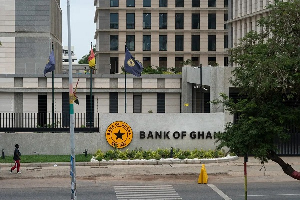
 Bank of Ghana headquarters
The microfinance industry has stepped up calls for recalibrating the Bank of Ghana’s (BoG) revised capital framework, urging a rethink of both the proposed minimum capital thresholds and their tight implementation timeline, even as it broadly endorses the direction of reform.
At a high-level roundtable in Accra convened by the Ghana Association of Microfinance Companies (GAMC), operators, consultants and academics cautioned that while the regulatory overhaul is well-intentioned, its current configuration could generate unintended consequences which undermine financial inclusion, distort market structure and amplify systemic fragility.
The discussions centred on BoG’s January 27, 2026 guidelines, which require existing institutions transitioning into Microfinance Banks to meet a minimum capital threshold of GH¢50million by December 31, 2026, while new entrants must raise GH¢100million.
The framework also replaces the longstanding Tier 1–4 classification with four new categories: Microfinance Banks, Community Banks, Credit Unions and Last Mile Providers.
With a pathway declaration deadline set for June 30, 2026, industry players say the compliance window is already under strain.
Reform objectives broadly accepted, but execution questioned
Across the board, participants stressed that the reform itself is not in dispute. Rather, the concern is whether its design sufficiently reflects the operational realities of Ghana’s microfinance ecosystem.
GAMC Board Chair Rebecca Addo, in setting the tone, described the intent of engagement as constructive rather than adversarial, insisting that industry concerns should be viewed as input into refinement rather than resistance to reform.
“Our engagement today should not be misconstrued as opposition to regulatory reform. It is a reflection of a shared conviction that meaningful reform must be ambitious in intent, but also grounded in practical realities of implementation and sector capacity,” she said.
She acknowledged that BoG’s objectives – including stronger governance, improved resilience, enhanced depositor protection and sector modernisation – align with long-standing industry aspirations.
The point of divergence however lies in how those objectives are translated into enforceable capital and structural requirements.
Capital threshold becomes focal point of concern
The framework’s most contested element is the GH¢50million minimum capital requirement for existing microfinance institutions seeking to operate as Microfinance Banks.
Industry operators argue that while recapitalisation is necessary, the scale of increase risks being disproportionate to the sector’s business model and client base.
Ebenezer Odame, Chief Executive-Equity Focus Microfinance, said the assumption that higher capital automatically resolves structural weaknesses is misplaced.
“Capital alone does not fix governance failures. The quality of supervision and internal discipline matters just as much,” he said.
He pointed to rural banking models as evidence that supervisory intensity and governance structures can matter more than absolute capital size in determining institutional stability.
From a macroeconomic standpoint, David Narh Aguda, Managing Consultant at Protégé Consult, warned that the uniform application of a GH¢50million threshold across over 130 institutions could create distortions in capital allocation.
He argued that the microfinance ecosystem – characterised by small average loan sizes and high-volume, low-margin transactions – may not be able to efficiently intermediate such large capital inflows without structural adjustment.
“Increasing capital is not in itself the problem. The issue is whether the sector can productively deploy that level of capital without fundamentally changing its risk profile and client focus,” he said.
Mr. Aguda warned that pressure to generate returns could push institutions toward higher-income clients, effectively shifting the sector away from its financial inclusion mandate and into direct competition with savings and loans companies and commercial banks.
He also raised concerns about whether governance systems, board capacity and risk management frameworks have evolved sufficiently to match the proposed balance sheet expansion.
“Your corporate governance structure will change completely. Your risk appetite will change completely. Nobody is talking about that. The directive on capital is there, but has there been any directive on how many board members you should have, what expertise they must bring? It is incomplete,” he noted.
“Somebody managing GH¢2million, the capacity to secure that – is that the same skillset we need for GH¢50million? At the moment, you have five board members. What level of expertise do you need on your board? Nobody is talking about that. The capital requirement is incomplete without addressing that,” Aguda further stated.
Lessons from past reforms shape current caution
For many stakeholders, the debate is shaped by recent history.
Dr Steven Bediako, Chief Executive Officer of MGI Microfinance, situated the current reform within the context of Ghana’s financial sector cleanup and earlier recapitalisation cycles, which saw capital requirements rise sharply from GH¢100,000 to GH¢2million under the transition to BoG supervision.
That period, he noted, was followed by widespread institutional distress and a significant contraction in the sector, which fell from roughly 347 institutions to about 120.
The concern, he suggested, is not reform fatigue but reform sequencing.
The question being asked is whether the system is being structurally strengthened or simply compressed into fewer, larger entities without resolving underlying weaknesses, he noted.
“When capital was raised from GH¢100,000 to GH¢2million, a lot of companies fell off. Public confidence in the microfinance sector became questionable. We moved from 347 institutions to about 120. That is the history we are sitting with,” he said.
Evidence-based calibration and data-driven thresholds
Academic voices at the roundtable called for a more empirical approach to capital setting.
Professor James Attah Peprah, Professor - School of Economics at University of Cape Coast, argued that the regulator is already in possession of granular sector data through routine reporting which could be used to derive more precise, risk-adjusted thresholds.
“Rather than applying a uniform figure, the regulator could work from actual balance sheet data to determine a capital range that reflects the sector’s real risk profile, with appropriate buffers built-in,” he said.
He cautioned that arbitrary thresholds risk incentivising financial engineering, including inflated asset valuations and related-party transactions, as institutions attempt to meet compliance targets without genuine strengthening of their underlying positions.
Prof. Peprah warned that the consequences of mass institutional failures could extend well beyond individual closures. A wave of exits, he cautioned, risks triggering sector-wide deposit runs as public panic spreads indiscriminately – threatening even well-capitalised institutions.
He also raised the question of whether the Ghana Deposit Protection Corporation will have the fiscal capacity to settle claims at the scale that simultaneous failures would generate. “Even those who have the GH¢50million, they won’t survive because everybody else is catching on like wildfire,” he said.
Push for tiered capital structure gains traction
Among the most consistent areas of convergence was support for a differentiated or tiered capital regime.
Operators argued that the current framework already implicitly recognises institutional diversity through its classification system, but this is not yet reflected in capital calibration.
The proposed alternative is a three-layer structure; primarily, community-level institutions with lower capital requirements and geographic restrictions.
Additionally, they suggested regional institutions with moderate capital thresholds as well as national microfinance banks with higher capital requirements and broader operational scope.
Under this model, capital requirements would scale with complexity, geographic reach and risk exposure rather than applying a single benchmark across the entire sector.
Some participants suggested that mid-tier institutions could operate more sustainably within a GH¢15million to GH¢20million capital band, though this was acknowledged as challenging for a portion of existing operators.
Timeline pressures and merger feasibility concerns
Beyond capital levels, the implementation timeline has emerged as a critical pressure point.
Institutions are required to submit pathway declarations by June 30, 2026, with full compliance expected by December 31, 2026.
Industry players argue that this compressed timeline is misaligned with the realities of financial restructuring, particularly mergers and acquisitions, which are expected to be a key compliance pathway.
David Narh Aguda noted that due diligence, valuation, regulatory approvals and integration processes typically require significantly longer timeframes than those provided under the current schedule.
He cautioned that rushed consolidation could introduce operational instability rather than resolving structural weaknesses.
A phased implementation model spanning three to five years, with staged capital milestones, was proposed as a more viable alternative that would allow institutions to adjust gradually while preserving depositor confidence.
He also expressed concerns that the reforms, if implemented in their current form, could squeeze out indigenous ownership in favour of foreign capital.
Financial inclusion risk remains central concern
The most politically sensitive argument raised is the potential impact on financial inclusion.
With an estimated 4.5 million customers across the microfinance sector, stakeholders warned that widespread consolidation or exits could leave large segments of the population without access to formal financial services.
These include market traders, smallholder farmers, artisans and informal-sector workers who rely on microfinance institutions for working capital and savings mobilisation.
Prof. Peprah warned that instability in one segment of the sector could trigger broader confidence shocks.
“Once confidence is eroded, the effects are rarely contained to weak institutions alone. Even sound institutions can face withdrawal pressure in a contagion scenario,” he said.
This concern echoes lessons from the financial sector clean-up period, when institution-specific failures quickly evolved into system-wide trust deficits.
Call for renewed engagement with regulator
Despite the concerns raised, participants emphasised continued openness to engagement with the Bank of Ghana.
GAMC leadership reiterated that the roundtable was intended as a contribution to policy refinement rather than opposition to regulatory authority.
Rebecca Addo underscored the need for structured dialogue ahead of the June 30 deadline.
“We remain committed to working constructively with the Bank of Ghana to ensure that the final framework reflects both regulatory ambition and sector realities,” she said.
However, stakeholders noted the central bank’s absence at the session, describing it as a missed opportunity for direct technical engagement.

Copyright © 1994 - 2026 GhanaWeb. All rights reserved.










