



The Chief Justice of the Republic of Ghana, Paul Baffoe-Bonnie, has called for a renewed national commitment to building a legal profession that produces lawyers worthy of defending justice, liberty and the rule of law.
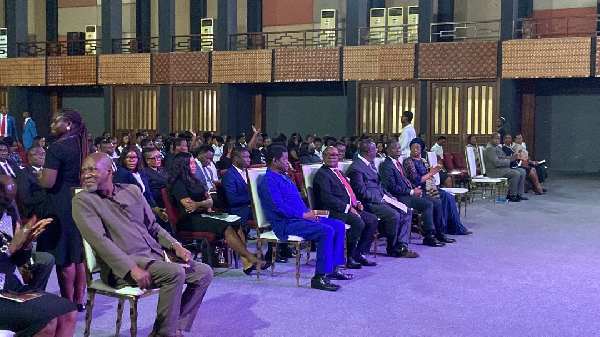
Speaking at the Central Law School of Central University’s colloquium on legal education reform in Ghana under the theme, “Implementing the Legal Education Act, 2026 (Act 1170): Institutional Readiness, Accreditation and the Future of Legal Training,” he said Ghana’s legal education system has, over the decades, produced some of the finest jurists, advocates, academics and public servants on the African continent.
However, he noted that growing concerns about access, institutional capacity, transparency and relevance necessitated urgent reforms.
“Let us preserve standards with integrity. Let us expand opportunity with fairness. And let us build a legal profession that truly reflects the constitutional ideals of our Republic, one that produces lawyers worthy of defending justice, liberty and the rule of law,” he said.
He explained that many qualified law graduates have faced difficulties accessing professional training, while inconsistencies in admissions, accreditation processes, and institutional coordination have also raised public concern.
He further highlighted the need to modernise legal education to reflect emerging fields such as technology, international commerce, and environmental law.
According to him, these concerns informed broad national consultations involving the Judiciary, Ghana Bar Association, universities, Parliament, students and civil society, culminating in the passage of the Legal Education Act, 2026 (Act 1170).
'He told us we were slaves' - Ghanaian fisherman wins justice after nine-year ordeal in Scotland
Describing the Act as a “mature and thoughtful national response,” the Chief Justice said it seeks to bridge Ghana’s legal education legacy with future demands.
He emphasised that the Judiciary must ensure that those who appear before the courts and those who will one day serve as judges are properly trained and ethically grounded.
He outlined five key objectives of the Act: expanding access to legal education, preserving professional standards, improving institutional coordination, modernising curricula and strengthening public confidence in legal training.
While acknowledging the importance of expanding access, he stressed that standards must not be compromised. Lawyers, he noted are officers of the court and custodians of the rule of law, and therefore require rigorous training, ethical grounding, and professional discipline.
He also called for stronger collaboration among law faculties, urging institutions to move beyond competition and embrace cooperation through joint research, academic exchanges, and shared training programmes.
According to him, legal education should be treated as a national project rather than an institutional rivalry.
The Chief Justice further highlighted the need to modernise legal education to reflect rapid global changes, including artificial intelligence, fintech, cybercrime, data protection and international arbitration. He said future lawyers must be technologically competent, ethically grounded and globally competitive.
He warned that poor training undermines justice delivery and public confidence in the legal system, stressing that reform implementation must be driven by institutions working in good faith.
He expressed optimism that successful implementation of the Act would expand opportunities, improve professional training, strengthen legal scholarship, and position Ghana as a leader in legal education in the region.
“The future of Ghana’s legal profession will be shaped significantly by the choices we make today.”
The Vice-Chancellor of Central University, Prof Samuel Kwasi Dartey-Baah, also addressed the colloquium, describing the Legal Education Act, 2026 as a landmark reform that represents a national conversation on access, excellence, and the future of justice in Ghana.
He said the reform must focus not only on increasing the number of lawyers but also on producing better-trained professionals who are ethically grounded, technologically competent, and socially conscious.
Prof Dartey-Baah cautioned that while access is essential, it must be balanced with quality, warning that “access without quality is dangerous, and quality without access is exclusion.”
He stressed that accreditation should be treated as a covenant with the nation, ensuring that institutions possess the necessary faculty strength, infrastructure, and ethical environment to produce competent legal professionals.
He further noted that the future of legal education must be more innovative, interdisciplinary, and responsive to global changes, adding that reform should ultimately strengthen justice delivery and democratic governance.
Dean of Central Law School at Central University, Prof Ken Agyemang Attafuah, Esq, described the enactment of Act 1170 as a watershed moment in Ghana’s legal education history.
He said the reform presents both opportunities and responsibilities for institutions, requiring a rethink of curriculum design, faculty development, infrastructure, and professional training approaches.
According to him, the colloquium was convened to deepen stakeholder understanding of the Act, assess institutional readiness, explore accreditation pathways, and develop practical strategies for implementation.
Prof Attafuah emphasised that universities must not only respond to reform but actively shape its success through collaboration with regulators, the Judiciary, and the legal profession.
He added that the success of the Act will depend on how effectively stakeholders translate policy into practice, and how well institutions prepare graduates for modern legal challenges.

AM
Engineers' body calls for mandatory verification of foundations before concrete works

Copyright © 1994 - 2026 GhanaWeb. All rights reserved.










