



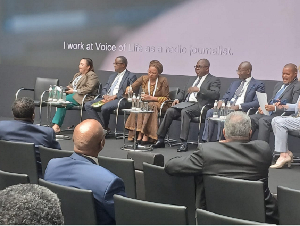
 Seidu Issifu is the Minister of State in charge of climate change and sustainability
The Minister of State for Climate Change and Sustainability, Seidu Issifu has called for stronger international action to protect the rights, dignity, and sovereignty of communities and nations threatened by sea-level rise and urged world leaders to place people at the centre of climate adaptation efforts.
Seidu Issifu disclosed this on behalf of President John Dramani Mahama at the High-Level Panel on “Protecting Rights in the Context of Sea-Level Rise” during the Berlin Climate Mobility Forum 2026 in Berlin-Germany on behalf of Ghana and the Vulnerable Twenty (V20) Group of Finance Ministers.
The Minister addressing government leaders, policymakers, development partners, and climate experts from around the world highlighted the growing threat posed by sea-level rise and stressed that the issue extends far beyond small island states.
He stated that “Sea-level rise is often described as a small island problem, but for countries like Ghana, it is a national development, economic, and human rights challenge,”.
According to him, nearly 40 percent of Ghana’s population lives along the coast, where major cities and economic centers including Accra, Tema, Keta, and Sekondi-Takoradi are increasingly exposed to coastal erosion, flooding, and climate-related disasters. Critical infrastructure such as ports, power facilities, industries, and transport networks is concentrated in these low-lying areas, making them highly vulnerable to the impacts of climate change.
Ghana’s partnership with the Global Centre for Climate Mobility through the Office of the Minister of State for Climate Change and Sustainability, the minister referenced projections indicating that a 0.5-meter rise in sea level by 2100 could place approximately US$3.8 billion worth of Ghana’s coastal assets at risk, representing a significant threat to national development and economic growth.
Speaking on behalf of the V20 Group, which represents nearly 70 climate-vulnerable countries and more than one billion people worldwide, he emphasized that sea-level rise poses a direct threat to livelihoods, cultural heritage, territorial integrity, and national sovereignty. From the Caribbean and Pacific Islands to the coastlines of Africa and Asia, communities are already experiencing the devastating consequences of rising seas.
Entire settlements face displacement, while cultural landmarks, historical sites, and traditional ways of life are increasingly at risk. The Minister stressed that climate action must not focus solely on infrastructure and engineering solutions but must also prioritize the protection of fundamental human rights.
A key theme of the Minister’s address was the need for legal certainty for countries facing the existential threat of sea-level rise.
He welcomed ongoing international discussions on the implications of sea-level rise for international law and supported calls for a United Nations declaration that guarantees the continuity of statehood and sovereignty, regardless of changes to coastlines caused by climate change.
The Minister pointed out that nations should not lose their legal identity or sovereign rights because of a climate crisis they did little to create and that “Countries must not cease to exist because their coastlines are changing. Legal clarity is essential for governments, citizens, investors, and future generations,” he emphasized.
The Minister also called for a significant shift in how climate adaptation finance is delivered, stressing that resources must reach vulnerable communities directly and without unnecessary delays.
While acknowledging international commitments under the Paris Agreement, Nationally Determined Contributions (NDCs), and National Adaptation Plans (NAPs), he noted that adaptation finance often remains inaccessible to the local communities that need it most.
To address this challenge, Ghana is piloting innovative approaches such as the Communities Climate Adaptation Facility (C-CAF), which empowers local authorities and communities to identify and implement adaptation measures tailored to their specific needs.
The Minister urged development partners and climate finance institutions to support decentralized and community-led financing mechanisms that strengthen local resilience and enable vulnerable populations to adapt effectively. The Minister further underscored the importance of ensuring dignity and protection for individuals and communities affected by climate-induced displacement.
While many coastal residents wish to remain on their ancestral lands, he acknowledged that relocation may become unavoidable in some cases and called for climate mobility policies that are planned, lawful, inclusive, and respectful of human dignity.
The Minister concluded by warning that the consequences of sea-level rise will extend far beyond vulnerable coastlines and affect the broader global economy. Flooded ports, disrupted supply chains, damaged infrastructure, and stranded assets in climate-vulnerable countries will inevitably impact international trade, investment, and financial systems worldwide.
He reminded delegates that while climate impacts may first be felt in vulnerable communities, their economic repercussions will be experienced across the globe.
Calling on governments, international organizations, financial institutions, and development partners to strengthen cooperation, the Minister urged participants at the Berlin Climate Mobility Forum to build a shared global consensus around protecting people, sovereignty, and sustainable development in the face of rising seas.
Reaffirming Ghana’s commitment to climate leadership and international collaboration, he stated that the country stands ready to work with partners across the world to advance practical and equitable solutions.
“Protecting rights in the context of sea-level rise means protecting people, protecting sovereignty, and protecting our shared economic future. Ghana remains committed to working with the international community to ensure that no nation and no community is left behind in the fight against climate change”.

Copyright © 1994 - 2026 GhanaWeb. All rights reserved.










