



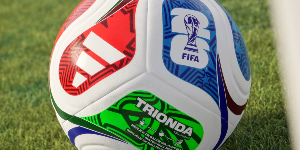
 A picture of the 2026 FIFA World Cup official Football
For decades, football supporters have argued over controversial decisions made by referees. Whether it was an offside call, a disputed handball, or a goal that should never have stood, the sport has long been defined by moments that sparked endless debate.
At the 2026 FIFA World Cup, however, technology is taking another major step towards reducing those arguments, and it all starts with the match ball.
2026 World Cup: Ghana must study referees as closely as opponents
The tournament's official ball, known as TRIONDA, is not just designed to fly faster or curve better. Hidden inside it is a sophisticated motion sensor capable of tracking every touch, movement and direction of the ball in real time.
For the first time, referees at football's biggest competition will have access to data generated directly from the ball itself, helping them make quicker and more accurate decisions during matches.
The innovation comes as the World Cup heads to North America, with the United States, Canada and Mexico jointly hosting the tournament.
The name "TRIONDA" reflects that historic partnership. Derived from Spanish words meaning "three waves", the ball pays tribute to the three host nations through its design and colours.
Its red, green and blue colour scheme represents the participating host countries, while the triangular pattern at the centre symbolises their unity in staging the tournament.
National symbols have also been incorporated into the design, including Canada's maple leaf, Mexico's eagle and the star associated with the United States.
Yet the most remarkable feature remains invisible.
At the heart of the ball is a sensor that records data 500 times every second. The system can determine exactly when a player touches the ball, how fast it is travelling and the direction it is moving.
That information is transmitted instantly to FIFA's officiating systems and works alongside the Video Assistant Referee (VAR) and Semi-Automated Offside Technology.
The result is a digital record of every touch made during a game.
Football authorities believe the technology could significantly improve decision-making, particularly in tight offside situations where fractions of a second often determine whether a goal stands or is ruled out.
By identifying the precise moment a pass is played, the ball helps match officials determine whether an attacking player was in an offside position.
The technology can also assist with reviews involving handballs, disputed possession changes and double touches during penalty kicks.
Perhaps one of the most surprising aspects of the new ball is that it needs electricity to function.
Unlike traditional footballs, TRIONDA contains electronic components that require charging before matches. The rechargeable sensor must be fully powered to ensure uninterrupted transmission of data throughout the game.
While the idea of charging a football may sound unusual to many supporters, it highlights the extent to which technology has become embedded in modern sport.
The innovations are not limited to electronics.
Adidas engineers have redesigned the ball using a four-panel construction intended to improve aerodynamics and ensure more stable flight.
Its surface also features embossed textures that enhance grip and control, especially during wet weather conditions.
According to FIFA and adidas, the improvements are aimed at making the ball more predictable in flight while allowing players to maintain greater control when passing, dribbling and shooting.
For football fans, including Ghanaians hoping to see the Black Stars make an impact on the global stage, the new ball offers a glimpse into a future where technology plays an increasingly influential role in the sport.
From goal-line technology to VAR and now sensor-equipped footballs, the game continues to evolve beyond what previous generations could have imagined.
Refereeing controversies may never completely disappear, but at the 2026 FIFA World Cup, officials will have more technological support than ever before.
And when the ball rolls across the pitch in North America, it will not simply be carrying the hopes of competing nations. It will also showcase how far football has travelled into the digital age.
NA/JE

Copyright © 1994 - 2026 GhanaWeb. All rights reserved.










