



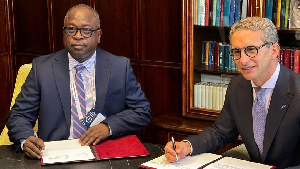
 Seidu Issifu leads Ghana-GCCM talks on climate mobility and social cohesion
Ghana and the Global Centre for Climate Mobility (GCCM) have agreed to strengthen their partnership to address the growing challenge of climate-induced mobility, promote social cohesion, and enhance regional cooperation across West Africa.
The commitment was reached during a bilateral meeting between the Minister of State for Climate Change and Sustainability, Seidu Issifu, and the Managing Director of the Global Centre for Climate Mobility, Prof. Kamal Amakrane, on the sidelines of the Berlin Climate Mobility Forum 2026.
The discussions focused on Ghana's leadership role in advancing climate mobility solutions at the national, regional, and global levels, as well as preparations for the upcoming Climate Mobility Summit in New York.
During the meeting, Hon. Issifu expressed Ghana's appreciation to the GCCM for its continued efforts in addressing climate change-related mobility and supporting vulnerable communities affected by climate impacts.
The Minister highlighted the work being undertaken by the Office of the Minister of State for Climate Change and Sustainability (OMSCCS) to integrate climate mobility considerations into national climate policies and development planning.
He noted that Ghana is working closely with government institutions, local authorities, development partners, and other stakeholders to ensure that climate mobility is reflected in adaptation planning, disaster risk management frameworks, and local governance systems.
According to the Minister, Ghana recognises that climate change is increasingly influencing patterns of migration and displacement, making it essential for governments to adopt proactive policies that protect vulnerable populations while promoting resilience and sustainable development.
A major theme of the discussions was the importance of social cohesion and peacebuilding in addressing climate-related displacement.
Prof. Amakrane, who described himself as "a peacekeeper rather than a diplomat," emphasised that climate mobility should not be viewed solely as a humanitarian or migration issue. Instead, he argued that it presents an opportunity for countries to strengthen social cohesion, foster regional solidarity, and prevent conflicts that may arise from displacement pressures.
He stressed that climate mobility discussions can serve as a platform for bringing countries together around shared solutions and common interests. In this regard, he encouraged Ghana to continue playing a leadership role in promoting climate mobility principles across Africa, particularly within the West African sub-region.
The GCCM Managing Director noted that Ghana's reputation for peace, stability, and democratic governance places it in a strong position to champion policies that ensure climate-related movement occurs in a safe, dignified, and orderly manner.
The meeting also explored opportunities for expanding GCCM's presence and engagement in West Africa.
Prof. Amakrane indicated that GCCM is ready to work closely with Ghana to strengthen advocacy efforts, mobilise resources, and support the development of strategic initiatives aimed at addressing climate-induced displacement across the region.
He further noted that GCCM could support the Minister in advancing climate mobility priorities through international platforms and facilitate access to funding opportunities that would help accelerate the implementation of related programmes and projects.
Prof. Amakrane proposed that Ghana take the lead in convening a sub-regional dialogue involving countries across West Africa. The proposed dialogue would create a platform for governments, regional institutions, and development partners to exchange experiences and coordinate responses to climate-induced mobility challenges.
The initiative is expected to encourage more countries to become active supporters of climate mobility principles while promoting policy alignment on issues such as planned relocation, protection of vulnerable populations, livelihood restoration, and human rights.
Both sides agreed that stronger regional cooperation would be critical to addressing the cross-border implications of climate change and ensuring that affected communities are supported in a coordinated and sustainable manner.
### Invitation to Climate Mobility Summit in New York
Prof. Amakrane appealed for Ghana's continued support in advancing the work of the GCCM and amplifying the voices of frontline countries most affected by climate change. He emphasised the need for stronger international partnerships and increased investments to address the growing challenges associated with climate mobility.
As part of efforts to deepen cooperation, Issifu indicated the possibility of facilitating a high-level meeting between the GCCM Managing Director and President John Dramani Mahama.
The proposed engagement would provide an opportunity to brief the President on the GCCM-Ghana partnership and explore Ghana's potential role in hosting regional climate mobility initiatives and strengthening Africa's contribution to global climate mobility discussions.
Seidu Issifu reaffirmed Ghana's commitment to advancing people-centred and rights-based approaches to climate mobility.
"Climate mobility is not just a humanitarian issue; it is a peace and development issue."
He pointed out that Ghana is ready to work with GCCM to show that when people must move due to climate change, it can be done with dignity, social cohesion, and regional solidarity.
Ghana, he said, remains committed to integrating climate mobility into its National Adaptation Plan and broader climate resilience agenda.
According to him, the country also intends to leverage international platforms, including future climate negotiations and global summits, to advocate for rights-based approaches that protect vulnerable populations while strengthening resilience and sustainable development.

Copyright © 1994 - 2026 GhanaWeb. All rights reserved.










