



 Ghana targets land restoration and drought resilience through stronger UNCCD collaboration
The Government of Ghana, through the Minister of State for Climate Change and Sustainability, Seidu Issifu, has reaffirmed its commitment to combating land degradation, strengthening food systems resilience, and enhancing drought preparedness through closer collaboration with the United Nations Convention to Combat Desertification (UNCCD), as the country prepares to participate in the Session of the Conference of the Parties to the Convention in Ulaanbaatar, Mongolia.
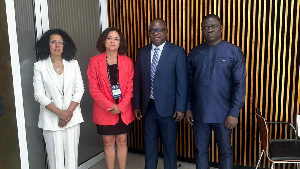
The commitment was underscored during a high-level bilateral meeting between the Minister and the Deputy Executive Secretary of the UNCCD, Andrea Meza Murillo, on the margins of the Berlin Climate Mobility Forum 2026.
The discussions focused on strengthening cooperation on land restoration, climate adaptation, drought resilience, sustainable agriculture, and climate finance, while identifying opportunities for Ghana to play a more active role in advancing Africa’s priorities at the upcoming conference.
The meeting comes at a critical time when many countries across Africa are facing increasing climate-related challenges, including prolonged droughts, declining soil fertility, land degradation, food insecurity, and climate-induced displacement.
Both parties acknowledged that addressing these interconnected challenges requires integrated solutions that place land restoration and sustainable land management at the centre of national and international climate action.
Seidu Issifu emphasised that drought is no longer an occasional environmental event but a persistent and structural challenge that is affecting livelihoods, economic development, and the resilience of communities.
He noted that in many African countries, including Ghana, agriculture remains a major source of employment and income, particularly for rural populations. However, changing rainfall patterns, prolonged dry spells, and declining land productivity continue to threaten the ability of farmers to produce sufficient food and sustain their livelihoods.
The Minister stressed the need for countries to move beyond reactive responses to drought and instead invest in long-term resilience measures that strengthen ecosystems, improve agricultural productivity, and protect vulnerable populations from climate shocks.
“Building resilience to drought is not only an environmental necessity but also an economic and social imperative."
Issifu highlighted several initiatives being implemented by Ghana to support climate-resilient agriculture and sustainable land management, including the National Climate-Smart Agriculture and Food Security Action Plan, the Accelerating Impacts of CGIAR Climate Research for Africa (AICCRA) programme, and the West Africa Food System Resilience Programme (FSRP). These interventions are helping to improve agricultural productivity, strengthen adaptation measures, and enhance food security for communities across the country.
Ghana Reaffirms Commitment to UNCCD
During the meeting, Ghana officially confirmed its participation in UNCCD conference, which will take place from August 17 to 28, 2026, in Ulaanbaatar, Mongolia.
The Minister informed the UNCCD leadership that Ghana intends to actively engage in the conference and contribute to global discussions on drought resilience, land restoration, climate adaptation, and sustainable development.
He noted that land degradation, mining activities, ecosystem conservation, and sustainable land management are closely interconnected and require strong collaboration among relevant ministries and stakeholders.
The Minister emphasised that Ghana remains committed to supporting global efforts aimed at achieving land degradation neutrality and promoting sustainable land management practices that contribute to economic growth, environmental protection, and social well-being.
The UNCCD leadership expressed interest in working with African governments to scale up investments that can reduce drought risks while creating economic opportunities for communities affected by climate change.
Issifu welcomed the initiative and expressed Ghana’s interest in exploring opportunities under the facility. He noted that the country would be interested in positioning itself as a potential pilot country for DRIF-supported investments, particularly in areas that combine environmental restoration with socio-economic development.
According to the Minister, strategic investments in land restoration can generate multiple benefits, including job creation, improved agricultural productivity, enhanced food security, biodiversity conservation, and reduced climate-induced migration.
He stressed that investing in resilience today would help prevent greater economic and social costs in the future.
Both parties agreed that the ministerial segment of COP17, scheduled for the final week of August 2026, would provide an important platform for advancing discussions on climate finance and mobilising resources to support drought resilience efforts worldwide.
Ghana’s Climate Prosperity Plan Attracting Green Investment
The Minister also briefed Ms. Meza Murillo on Ghana’s Climate Prosperity Plan (CPP), which has recently been validated as a national investment framework aimed at attracting climate and green finance to support sustainable development.
He explained that the CPP identifies strategic investment opportunities across key sectors, including climate-smart agriculture, renewable energy, sustainable land management, and nature-based solutions.
The framework seeks to create an enabling environment for public and private sector investment while accelerating Ghana’s transition to a climate-resilient and low-carbon economy.
Issifu emphasised that the Climate Prosperity Plan aligns strongly with the objectives of the UNCCD and provides a practical mechanism for channelling investment into initiatives that restore degraded lands, strengthen food systems, and improve resilience to drought and other climate impacts.
The discussions highlighted the growing recognition that restoring ecosystems and improving land management practices can play a critical role in reducing poverty, enhancing food security, creating employment opportunities, and building resilience against climate change.
As climate impacts continue to intensify globally, the meeting underscored the need for stronger partnerships between governments, international organisations, development partners, financial institutions, and the private sector to mobilise the resources required for transformative action.
Seidu Issifu reaffirmed Ghana’s determination to contribute meaningfully to global efforts aimed at combating desertification and building drought resilience.
“Land is Ghana’s first line of defence. When our soils degrade and rains become erratic, food security and livelihoods suffer, and people move."
According to him, Ghana remains an active Party to the UNCCD and continues to align its national policies, including the National Drought Plan, with the Convention’s 2018–2030 Strategic Framework through strengthened partnerships, innovative financing, and sustainable land management practices.
Ghana is also positioning itself as a leader in advancing resilience, restoring ecosystems, and securing a sustainable future for present and future generations.
The bilateral meeting marks another important step in Ghana’s efforts to place land restoration, climate adaptation, and food systems resilience at the heart of national development and international climate action ahead of the conference.

Copyright © 1994 - 2026 GhanaWeb. All rights reserved.










