



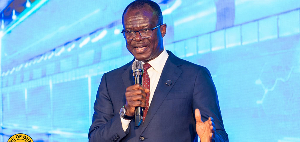
 Dr Zakari Mumuni, First Deputy Governor of the Bank of Ghana (BoG)
The First Deputy Governor of the Bank of Ghana (BoG), Dr Zakari Mumuni, has called for a coordinated approach to building Africa's digital assets economy, stressing that innovation must be anchored on trust, strong institutions and financial stability.
Speaking at the Standard Chartered Digital Assets Summit in Accra on June 19, 2026, Dr Mumuni said Africa stands at a critical moment as digital finance rapidly reshapes how value is stored, transferred and exchanged across borders.
He noted that the continent must ensure technological progress benefits businesses and consumers while maintaining confidence in the financial system.
According to him, digital assets have already become a significant part of Ghana's financial landscape, reaching millions of users and generating transactions worth billions of dollars.
Dr Mumuni argued that the debate is no longer about whether digital assets will influence African finance, but rather how governments and regulators can shape that future to support entrepreneurs, traders and small businesses across the continent.
"Africa's digital asset economy must not be built on speculation. It must be built on trust, inclusion and sound institutions," he stated.
Adu-Boahene's invoice for cyber defence system was fake – EOCO officer
The first Deputy Governor also used the platform to address concerns about the future of Ghana's national currency amid the rapid growth of digital finance.
He maintained that technological innovation should complement, rather than replace, the country's legal tender.
"But let me be absolutely clear: Whatever we build, tokenize or otherwise, we must not displace the cedi. A strong digital ecosystem should strengthen public money, not compete with it. The future may be digital, but public trust must remain at its centre," he said.
Dr Mumuni identified cross-border payments, tokenisation of real-world assets and financial inclusion as some of the key opportunities emerging from Africa's digital transformation.
He observed that digital settlement systems could make it easier and more affordable for businesses across African countries to trade with one another, thereby supporting the objectives of the African Continental Free Trade Area (AfCFTA).
He further noted that emerging digital infrastructure could widen access to finance and extend financial services to underserved communities.
However, he cautioned that innovation must go hand in hand with consumer protection, financial literacy and effective regulatory oversight.
"Financial stability matters, just like consumer protection, integrity and literacy. Innovation succeeds when people trust it, and people trust it when they understand it," he said.
Concluding his remarks, Dr Mumuni urged innovators, financial institutions, regulators and investors to work together to build a connected and inclusive African digital economy.
"To innovators, engage with us. To banks, partner with us. To regulators across Africa, collaborate with us. Because interoperability is not an accident of technology; it is a policy choice. And it is a continental choice," he stated.
ANAS/MA
Inside the AI revolution that could save lives on Ghana's roads

Copyright © 1994 - 2026 GhanaWeb. All rights reserved.










