



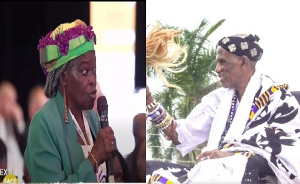
 Surinamese woman (L) highlights cultural similarities between Ghana and Suriname
A Surinamese woman has reignited conversations on reparatory justice by projecting striking cultural similarities between Ghana and Suriname during the NEXT Steps Conference held in Accra.
The conference, a high-level consultative forum on reparatory justice, took place from June 17 to 19, 2026, and brought together global leaders and stakeholders to discuss pathways toward justice and redress for the transatlantic slave trade and its enduring impacts.
In a video shared by Face to Face and sighted by GhanaWeb on June 23, 2026, the woman captivated participants by highlighting similarities between cultural practices, names of places, language, and traditional leadership structures in Ghana and Suriname.
According to her, many cultural elements in Suriname bear strong resemblance to those found in Ghana, suggesting a possible historical ties between the two countries.
"When we talk about reparations, Suriname must be counted in," she said.
"One of the first examples is chieftaincy. We have six kingdoms in Suriname, and in their own languages they call their leaders 'Ga Mang.' I heard that in Ghana you call them 'Ga Mantse.' They have similar rules and guidelines," she added.
Ghana’s culture still alive
She further pointed to place names and personal names that she believes reflect Ghanaian influence.
"We have a village called Tamale in Suriname. We have names like Tumu, Tamba, and Damba. These people are still living with traditions that are very similar to those in Africa," she stated.
The woman also highlighted culinary similarities between the two countries.
"The food is another example. I'm telling everybody that Suriname has the best fufu, the best gari, the best groundnut soup, and the best okra soup," she said amid laughter from the audience.
She noted that names such as Agidi, Yao, and Chamba have long existed in Suriname, adding that these cultural markers date back centuries.
"There is so much more to learn about reparations through a country like Suriname. When I say 'ɛyɛ,' it means good. In Suriname, 'kaba kaba' means ready, and 'kaaba' means stop. Suriname needs to be included in the reparatory justice conversation," she added.
Her remarks sparked interest among participants, many of whom viewed the examples as evidence of the enduring cultural legacy of Africans who were forcibly transported across the Atlantic during the slave trade.
Suriname, officially known as the Republic of Suriname, is located on the northern coast of South America and is often considered part of the Caribbean region. The country's population includes a significant Afro-Surinamese community descended from enslaved Africans.
According to historical records, Afro-Surinamese people account for approximately 37.4 percent of the country's population and are broadly divided into Creoles and Maroons. The Maroons, descendants of escaped enslaved Africans, established independent communities in remote forest areas and continue to preserve many African cultural traditions.
Suriname was a Dutch colony from 1667 until 1954 and later became an autonomous country within the Kingdom of the Netherlands. It gained full independence on November 25, 1975.
The woman's remarks added a cultural dimension to ongoing discussions about reparatory justice, highlighting how African traditions, languages, and identities continue to thrive across the diaspora centuries after the transatlantic slave trade.
Watch video below

Copyright © 1994 - 2026 GhanaWeb. All rights reserved.










