



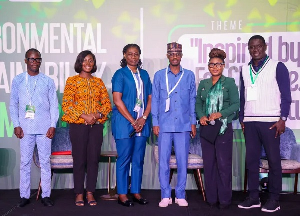
 Environmental sustainability experts say behavioural change is key
Environmental sustainability experts have identified behavioural change as the most important innovation needed to transform the waste management sector, arguing that the country’s ability to tap into the global waste management market begins with a shift in mindset rather than investment in machinery.
Speaking at the 2026 Environmental Sustainability Summit (ESS) organised by the Business & Financial Times (B&FT) in Accra, panellists said failure to view waste as an economic resource continues to undermine efforts to improve sanitation, create jobs and expand economic opportunities.
Discussing the theme “Green Innovation and Technology: Driving Sustainable Economic Growth”, the experts noted that while technology remains essential, the greater challenge lies in scaling, financing and commercialising existing solutions.
Senior Sustainability Officer at the Jospong Green Transition Office, Dr Gloria Boamah Kusi, stressed that innovation starts when waste is recognised as a valuable resource rather than a nuisance.
She said public education, particularly among children, is critical to changing attitudes toward waste management and reducing over reliance on government and private waste management firms.
Dr Kusi observed that although waste segregation is gaining traction, weak collection systems often undermine the process, as segregated waste is frequently mixed during transportation. She cited Milan, Italy, where 60 percent of waste is segregated at source and more than 120,000 tonnes of organic waste are diverted annually to biogas plants, as a model Ghana could emulate.
The panel called for a formalised waste collection system that preserves the integrity of segregated waste from households to processing facilities.
With the global waste management market estimated at US$1.6 trillion and projected to reach US$2.5 trillion by 2050, panellists described the sector as a significant opportunity for job creation and economic growth. Unlike finite natural resources such as gold and diamonds, waste is generated continuously, providing a sustainable resource base for economies able to harness it effectively.
Energy, sustainability and ESG analyst Ibrahim Adle Muhammad said many organisations still regard sustainability initiatives as costly, slowing their adoption across industries. He argued that changing perceptions about the economic value of waste would accelerate investment and innovation, noting that locally developed sensor-based waste segregation technologies require only financing to scale.
The discussion also highlighted the gap between academic research and commercial application. Professor Michael Tuffour of the University of Environment and Sustainable Development urged universities to transform research outputs into commercially viable enterprises capable of attracting investment and creating jobs.
He identified four critical pillars for achieving meaningful socio-economic impact: policy alignment, business commercialisation of green innovations, research commercialisation and citizen participation through greater awareness of waste as a resource.
Meanwhile, Chief Executive Officer of the Chamber of ESG & Sustainability Ghana, Frank Adu Anim, pointed to weak Environmental, Social and Governance (ESG) compliance among small and medium-sized enterprises, particularly within the informal sector where enforcement remains limited.
He called on manufacturers to move beyond traditional corporate social responsibility initiatives and adopt product designs that reduce material use and promote lifecycle recycling.
The panellists further challenged the perception that sustainability requires significant expenditure, noting that simple actions such as switching off unused lights and air conditioners, conserving water and using designated waste bins represent the first steps toward behavioural change.
They concluded that the country already possesses many of the green technologies and innovations needed to drive sustainable growth, but success will depend on the ability to finance, scale and institutionalise them before the expanding global opportunity is lost.

Copyright © 1994 - 2026 GhanaWeb. All rights reserved.










