



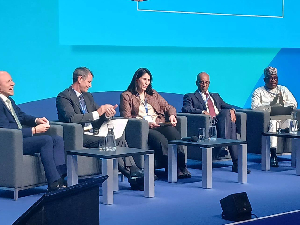
 Ghana called for longer-term concessional financing
Ghana has reaffirmed its commitment to advancing climate resilience and sustainable development by endorsing the Vulnerability to Viability (V2V) Compact, joining 74 member countries of the Vulnerable Twenty (V20) Group as founding signatories at its official launch in Vienna.
Speaking on behalf of President John Dramani Mahama, the Minister of State for Climate Change and Sustainability, Seidu Issifu, described the V2V Compact as a transformative initiative that will help climate-vulnerable countries overcome the high cost of financing resilience and development projects.
The Minister made this known while addressing world leaders, development finance institutions, multilateral development banks, and international partners in Austria.
He noted that despite having viable projects, climate-vulnerable economies such as Ghana continue to face disproportionately high borrowing costs because global financial systems do not adequately account for climate vulnerability.
He highlighted the severe impacts of recent climate-related shocks in Ghana, including devastating floods in the Volta Basin and mounting fiscal pressures that have forced difficult choices between servicing debt and investing in critical sectors such as health and education.
He said, “Ghana supports the V2V Compact because it provides a pathway to break the vulnerability trap, ensuring that climate disasters do not interrupt essential services such as healthcare, education, and water supply.”
Ghana expressed strong support for the Compact’s four key action pillars: scaling concessional financing, mobilising private capital, strengthening country ownership, and promoting shock-responsive financial instruments.
The country called for longer-term concessional financing, particularly 50-year loan tenors for investments in water, health, and education, stressing that such financing is a necessity rather than a luxury for low-income, climate-vulnerable countries.
On private sector investment, Ghana advocated innovative financing mechanisms including first-loss guarantees, local currency lending, and viability gap funding to make critical social infrastructure projects more attractive and affordable.
Reaffirming the importance of national leadership, Seidu Issifu emphasised that climate finance should be aligned with country-owned development platforms. He noted that Ghana’s Climate Prosperity Plan, with an investment pipeline valued at US$15 billion, serves as the country’s framework for mobilising climate finance and private investment in resilient infrastructure.
He also underscored the need for faster access to emergency financing, noting that experiences from the COVID-19 pandemic and the Akosombo Dam spillage demonstrated the importance of rapid financial support during crises.
As part of its national commitments under the Compact, Ghana announced plans to establish a National V2V Delivery Unit jointly anchored within the Ministry of Finance and the Office of the Minister of State for Climate Change and Sustainability.
The country will also launch a Pooled Project Preparation Facility for water and health public-private partnerships in 2027, share its Accra Climate Prosperity Plan as a model for country-led investment pipelines, and champion the development of a White Paper ahead of the upcoming World Bank and IMF Annual Meetings.
Ghana further called on development finance institutions to provide predictable concessional financing, strengthen coordination among partners, and expand risk-sharing instruments capable of unlocking large-scale investments.
The Minister concluded; “Climate justice is not charity; it is rational economics.”
He stressed that Ghana remains committed to working with international partners to ensure that by 2030, vulnerability is no longer viewed as a credit risk but as a challenge overcome through collective action.
The launch of the V2V Compact marks a significant milestone in global efforts to reform climate finance and improve access to affordable capital for countries most vulnerable to the impacts of climate change.

Copyright © 1994 - 2026 GhanaWeb. All rights reserved.










