



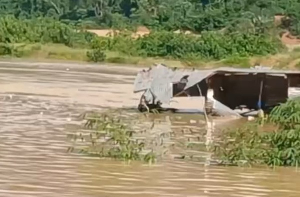
 A file photo of the flood situation in Accra
The Municipal Director of the National Disaster Management Organisation (NADMO) for Weija-Gbawe, Emmanuel Kwame Essel, has rejected claims attributing the widespread flooding in parts of the Weija-Gbawe municipality to the ongoing dam spillage.
Speaking exclusively to GhanaWeb on June 29, 2026, he blamed the current flood in the area to years of poor drainage management and encroachment on waterways.
Essel said the heavy rains had exposed long-standing failures in the municipality, including blocked waterways, illegal construction on water channels and the failure to dredge drains over the past decade.
Man reportedly swept away by floodwaters at Kasoa
"This rain is both a curse and a blessing because it has exposed the negligence in our communities. People have built on waterways, drains have been blocked, and for the past 10 years many of the waterways have not been dredged," he said.
He stressed that the current flooding should not be blamed on the ongoing controlled Weija Dam spillage, explaining that the hardest-hit areas, including Mallam and Gbawe, were affected mainly by overflowing rivers and streams rather than water released from the dam.
"The major cause of flooding at Mallam and Gbawe is not the spillage. These areas are affected by rivers and streams flowing from places such as Amasaman, Anyaa and Upper Weija towards the sea," Essel explained.
According to him, the ongoing spillage from the Weija Dam has reduced significantly and would only affect low-lying communities along its natural course, including parts of Weija East, Tetegu and Oblogo.
He noted that the latest flooding was triggered largely by the intensity of the rainfall, which fell continuously from Sunday night June 28, 2026 into Monday June 29, 2026.
"The spillage is still ongoing but it has been reduced. What we are witnessing now is mainly the result of the heavy rains. The water has even washed away roads and damaged properties because many of the drainage channels have been obstructed," he stated.
Essel added that rescue teams from NADMO remain on the ground responding to distress calls across affected communities.
He urged residents to refrain from building on waterways and called for sustained investment in drainage infrastructure to reduce the impact of future floods.
ANNAS/VPO
GH¢20 and a Ghana Card are all you need to invest in NIMED CAPITAL – CEO

Copyright © 1994 - 2026 GhanaWeb. All rights reserved.










