



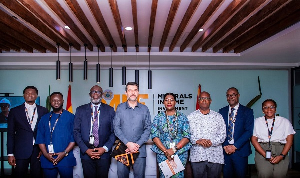
 The meeting was held at the MIIF boardroom in Accra on Thursday, June 25, 2026
The Minerals Income Investment Fund (MIIF) and the International Monetary Fund (IMF) have held high-level discussions on strengthening Ghana's mining sector, with a particular focus on increasing mineral revenue mobilisation and accelerating the formalisation of the small-scale mining sector, especially in relation to royalty payments.
The meeting, held at the MIIF boardroom in Accra on Thursday, June 25, 2026, brought together an IMF delegation led by Resident Representative, Dr Adrian Alter, and a MIIF team headed by the Fund's Chief Executive Officer, Justina Nelson.
During the discussions, Nelson said strategic reforms and stronger collaboration with key sector institutions had significantly improved mineral royalty collections since MIIF became operational in 2020.
How POS fraudsters allegedly turned fuel stations into cash-out points in Ghana
She disclosed that royalty inflows had increased by nearly 500% over the period, with the Fund recording more than GH¢5 billion in mineral royalties for the first time in its history in 2025.
According to her, the milestone reflects stronger revenue mobilisation efforts despite exchange rate fluctuations and prevailing market conditions.
Nelson noted that the small-scale mining sector continues to hold enormous potential for Ghana's economic transformation.
She said MIIF is working closely with institutions including the Ghana Revenue Authority (GRA), Minerals Commission, Ghana Gold Board, and the Ghana National Association of Small-Scale Miners to strengthen governance systems and improve royalty collection mechanisms.
The Head of Investment at MIIF, Ernest Attiso, outlined the Fund's mandate to maximise mineral royalty collections in partnership with the Ghana Revenue Authority while investing mineral revenues for the benefit of both current and future generations.
He also highlighted MIIF's three-year strategic plan, which runs through 2028 and focuses on improving royalty mobilisation, strengthening governance, compliance, controls and risk management, as well as growing the Fund's Assets Under Management (AUM).
Attiso said the Fund is pursuing opportunities across mineral exploration, near-production assets, processing and beneficiation infrastructure, small-scale mining formalisation, and royalty and streaming financing models.
Beyond financial returns, he reaffirmed MIIF's commitment to Environmental, Social and Governance (ESG) principles through initiatives such as afforestation, heritage and tourism development, and women empowerment programmes in mining communities.
For his part, IMF Resident Representative Dr Adrian Alter shared the Fund's perspectives on Ghana's mining sector, particularly the relationship between the IMF's Policy Coordination Instrument (PCI) and MIIF's operations.
He emphasised the importance of fiscal discipline, debt sustainability, domestic revenue mobilisation, stronger state-owned enterprises, financial sector development, and sustained private sector-led growth.
Dr Alter also stressed the need to strengthen governance, transparency, reporting standards and the management of fiscal risks associated with state-owned entities.
On small-scale mining, he observed that although the sector contributes significantly to mineral production, it continues to record relatively low formal royalty collections due to informality and environmental challenges. He expressed hope that MIIF would play a leading role in addressing these issues.
He also sought MIIF's views on the Sliding Scale Royalty Framework, particularly how it balances government revenue objectives with investor confidence.
MIIF indicated its support for the framework, describing it as a balanced mechanism that adjusts royalties in line with commodity price movements.
Dr Alter further highlighted concerns about concentration risks within Ghana's mineral sector and underscored the importance of timely audited financial statements, adherence to national reporting frameworks, and stronger public accountability.

Copyright © 1994 - 2026 GhanaWeb. All rights reserved.










