



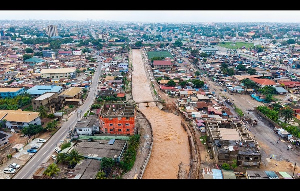
 Every rainy season now tells a familiar story
For decades, Accra has served as Ghana’s political, commercial, and diplomatic capital. It has driven national growth, attracted investment, and projected the country’s image globally. Yet today, the city that has long supported the nation’s development is becoming increasingly vulnerable to one of the defining challenges of the twenty-first century—climate change.
Every rainy season now tells a familiar story.
Heavy rainfall overwhelms drainage systems. Roads turn into rivers. Homes are submerged. Businesses shut down. Vehicles are damaged. Public infrastructure is destroyed. Families lose livelihoods, savings, and in some cases, lives. Government is forced to divert scarce resources from development into emergency response and reconstruction.
Once the floodwaters recede, the country prepares for the next rainy season.
This has become one of Ghana’s most costly recurring national challenges.
A growing economic and climate risk
The question confronting Ghana is whether it can continue concentrating the Presidency, Parliament, ministries, security institutions, courts, and key economic infrastructure in one of the country’s most climate-exposed coastal cities.
According to World Bank-supported flood resilience assessments, more than US$3 billion worth of economic assets in the Greater Accra Region are exposed to flood risk. These include transport infrastructure, commercial buildings, industries, hospitals, schools, utilities, government facilities, and residential developments.
Climate projections indicate increasing rainfall intensity across West Africa. Combined with rapid urbanisation, poor drainage management, loss of wetlands, and rising sea levels, each year places greater pressure on already vulnerable infrastructure.
Flooding is no longer just an environmental issue—it has become an economic and national security concern.
Every major flood disrupts transport, manufacturing, banking, retail, telecommunications, healthcare, and education. Businesses lose inventory. Factories shut down. Supply chains break. Workers lose productive hours. Insurance claims rise. Asset values weaken. Investor confidence is affected as climate risk becomes a key factor in commercial decisions.
Government also bears a heavy cost.
Billions of cedis that could support industrialisation, education, healthcare, housing, and job creation are repeatedly redirected to disaster response, drainage rehabilitation, and infrastructure repair.
Meanwhile, ordinary citizens carry the greatest burden. Small businesses collapse. Informal traders lose stock without compensation. Families are pushed deeper into poverty after every major flood.
The cost of rebuilding yesterday continues to grow every year.
Beyond drainage: the need for structural change
Ghana therefore needs more than incremental drainage improvements. It needs a long-term national resilience strategy.
One option that warrants serious consideration is the gradual relocation of the administrative capital to a safer inland location, while allowing Accra to retain its role as the country’s commercial, financial, maritime, and diplomatic hub.
A National Capital Corridor concept
Rather than building an isolated new capital city, Ghana could pursue a transformative national development strategy anchored on the proposed Accra–Kumasi Expressway Corridor.
This could serve as the backbone of a National Capital Corridor—a climate-resilient administrative and economic spine linking Ghana’s two most important urban and economic regions.
A corridor shaped by geography
One of the corridor’s major advantages lies in its natural elevation profile. Unlike the low-lying coastal plains of Accra, the route gradually rises inland into more stable terrain:
Accra: 20–60 metres above sea level
Adeiso: 60 metres
Asamankese: 147 metres
Akyem Oda: 132 metres
Ofoase: 220–260 metres
Lake Bosomtwe: 150 metres
Kumasi: 250 metres
The corridor climbs steadily from the coast through the Eastern Region into the Ashanti Plateau.
This elevation provides a natural advantage for climate-resilient planning, reduced flood exposure, improved drainage capacity, and long-term infrastructure stability.
It also offers space for planned development—government districts, housing, universities, hospitals, industrial parks, and logistics hubs—without the severe land constraints currently facing Accra.
Learning from global experience
Ghana would not be the first country to rethink its administrative geography.
Countries such as Brazil, Nigeria, and Indonesia have relocated or restructured capital functions to promote balanced development and reduce pressure on coastal cities.
The United Arab Emirates has also demonstrated how coordinated development corridors can drive economic transformation by linking infrastructure, logistics, and urban expansion.
Ghana can adopt and adapt these lessons.
A well-planned Accra–Kumasi corridor could integrate highways, rail systems, digital infrastructure, energy networks, and smart urban centres into a single coordinated national framework.
More than relocation: economic transformation
A National Capital Corridor would do more than move government institutions.
It would reshape Ghana’s economic geography, unlock billions in investment, generate large-scale employment, and ease pressure on Accra while promoting regional balance.
It would also support climate adaptation by directing future development to higher, safer ground.
Economic experts may argue that relocation is expensive—and they would be right.
But an equally important question must be asked:
How much will Ghana continue to spend over the next 50 years rebuilding flood-damaged infrastructure, compensating disaster losses, and disrupting economic activity every rainy season?
At what point does reaction become more expensive than planning?
A strategic choice for the future
This is not a proposal to abandon Accra.
Accra will remain Ghana’s commercial gateway and financial hub. But the country’s administrative backbone may need to evolve to match new climate realities.
The rains will continue. Climate risks will increase. Economic losses will mount.
The real question is whether Ghana will continue rebuilding a vulnerable past—or begin constructing a resilient future.
The time for that national conversation is now.

Copyright © 1994 - 2026 GhanaWeb. All rights reserved.










