



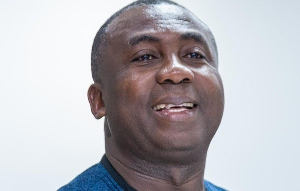
 President of the Association, Nana Dr Emmanuel Adu-Sarkodee
The Ghana Employers Association (GEA) has proposed an ambitious National Home Ownership Programme aimed at addressing Ghana’s estimated 1.8 million housing deficit while creating hundreds of thousands of jobs and driving economic growth.
The proposal, which seeks to integrate housing development into the government’s 24-hour Economy Programme, was presented by the President of the Association, Nana Dr Emmanuel Adu-Sarkodee, on Friday, June 26, 2026, during the 2nd National Labour Conference in Ho in the Volta Region.
Addressing participants under the theme “Strengthening Industrial Harmony as a Catalyst for Accelerated Economic Growth and National Development,” Dr Adu-Sarkodee said industrial peace alone was not enough to guarantee productivity if workers continued to struggle with access to decent and affordable housing.
He argued that addressing the housing deficit would significantly improve workers’ welfare and national productivity.
He noted that Ghana’s housing deficit currently stands at about 1.8 million units, despite successive governments introducing various housing programmes over the years.
However, he observed that many houses developed under previous initiatives remained beyond the reach of ordinary workers, while implementation challenges had prevented several policies from achieving their intended outcomes.
Dr Adu-Sarkodee said many essential workers, including teachers, nurses, police officers, and other public servants, had abandoned the dream of home ownership due to unfavourable mortgage conditions.
According to him, the inability of workers to own homes results in long commuting hours, rising rental costs, financial stress, and reduced productivity.
“It is imperative to indicate that a nation is not measured by the wealth it holds in its vaults, but by how many of its people have a place they can call their own,” he said, stressing that every Ghanaian deserves access to affordable housing.
To address the challenge, the GEA proposed the construction of 1.8 million standardised two-bedroom houses in partnership with government and relevant stakeholders. Under the proposal, each housing unit would cost an estimated GH¢250,000 and be financed through a long-term mortgage arrangement at about 8% interest over 25 years.
Dr. Adu-Sarkodee explained that this would reduce monthly mortgage payments to approximately GH¢1,900, making home ownership more accessible to a significant portion of middle-income workers in both the public and private sectors. He said this represents a major shift from the current mortgage market, where interest rates of 25% to 28% have priced many Ghanaians out of home ownership.
He noted that improving macroeconomic conditions present a unique opportunity for such a programme, citing a decline in inflation from about 18% to below 4%, and a reduction in the policy rate from 30% to 14%, creating more favourable conditions for affordable housing finance.
Beyond addressing the housing deficit, he said the initiative would generate significant economic benefits. He estimated that constructing 1.8 million houses would require about GH¢450 billion in investment and could generate over GH¢900 billion in economic activity across manufacturing, construction, transport, retail trade, and financial services.
He further estimated that the programme could create about 4.5 million person-years of employment, supporting between 650,000 and 800,000 jobs annually, making it one of the largest employment-generation initiatives in Ghana’s history.
Dr. Adu-Sarkodee recommended integrating the National Home Ownership Programme into the government’s 24-hour Economy Programme, stressing that its success would depend on sustainable housing finance, strategic release of state lands, and reforms to Ghana’s land administration system.
He expressed concern about persistent land litigation, noting that businesses often acquire land only to face lengthy court disputes that delay projects and increase costs. He called for stronger collaboration between the Lands Commission and Metropolitan, Municipal and District Assemblies to ensure secure land titles and faster registration processes.
He also proposed that the programme should initially target teachers, nurses, civil servants, and security personnel. He added that mortgages would be backed by insurance to protect both beneficiaries and lenders in cases of death or permanent disability.
“The programme will not only address Ghana’s housing deficit, it will also become a powerful engine for inclusive transformation. We will build with our own hands—our own sockets, pipes and doors—manufactured in our own factories, with up to 90 per cent local content,” he said.
Dr. Adu-Sarkodee said the Association has developed a concept note for the initiative and is ready to engage government and stakeholders on its implementation. He expressed confidence that the programme would create homeowners, strengthen local industries, generate employment, and contribute significantly to Ghana’s long-term economic transformation, while commending government for maintaining dialogue with employers and organised labour.

Copyright © 1994 - 2026 GhanaWeb. All rights reserved.










