



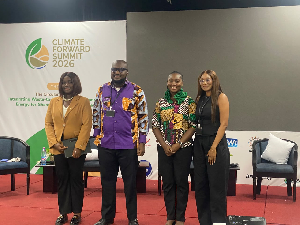
 From L to R: Juliet Nortey, Dr Gloria Kusi and Bombade
Development Planning Officer at the Ministry of Environment, Science and Technology, Juliet Nortey, has stated that Ghana requires about US$9.5 billion annually to implement policies aimed at promoting circularity and waste management.
Speaking at the Climate Forward Summit held at the Ghana Institute of Management and Public Administration (GIMPA), Nortey identified inadequate financing and limited technical capacity as major obstacles to Ghana’s green transition.
While making her submission during a panel discussion on the topic “Governing the Green Transition: Policy, Finance, People and Technology for Ghana’s Circular Industrial Future" Nortey noted that Ghana has developed strong policies to support sustainable development, but implementation remains a major challenge.
“We have very brilliant policies, but the greatest challenge is implementation. Implementation is always a challenge, and certain things are helpful. The challenges that we face when it comes to implementation, the first one is finance. For the economy to do well, we need money,” she said.
She explained that the country’s Nationally Determined Contributions (NDCs), including the draft NDC 2.0, contain provisions on circularity and waste management.
“If you look at our previous NDCs and our current NDC 2.0, which we are currently drafting, as I highlighted earlier, they contain components that capture circularity and waste management. We need about US$9.5 billion per year to achieve this target."
Nortey also identified capacity gaps, particularly at the sub-national and community levels, as another key challenge affecting the implementation of environmental policies.
She said many experts responsible for implementing environmental interventions lack the technical knowledge needed to translate policy frameworks into practical action.
“The second part also has to do with another challenge that we face, which is capacity. When it comes to capacity, you find that most of our experts, particularly at the sub-national level and the community level, lack capacity," she added.
Also speaking at the summit, under the theme “The Circular Transition: Integrating Waste-to-Wealth Pathways and Clean Energy for Ghana’s Green Industrialisation," Senior Sustainability Officer at Jospong Group of Companies, Dr Gloria Boamah Kusi, called for collective action in addressing Ghana’s waste management challenges.
She stressed that the implementation of environmental policies should not be left to the government or private sector alone, urging citizens to take responsibility by reporting indiscriminate dumping and other poor sanitation practices.
“The implementation is not for the government alone; it is not for the private sector alone. We have these conferences, but let’s start with ourselves. The government will bring the policy, but don’t sit aloof and watch the government implement it,” she said.
Dr Kusi encouraged Ghanaians to use social media platforms to expose indiscriminate dumping and heaps of waste before disasters occur.
“Can we take pictures when we see people dumping indiscriminately? Can we take pictures when we see heaps of waste? Can we blog these things in our own language? We should not wait for disaster before we start putting all of this on TikTok. It is really disheartening,” Dr Kusi added.
Maria-Ancilla Bombande, a Research Associate at United Nations University Institute for Natural Resources in Africa, also called for a shared approach to implementing Ghana’s environmental and waste-management policies.
She urged households to take responsibility for proper waste disposal while calling on the government to strengthen efforts to ensure public safety.
“The policy has been implemented, and it has been announced to us as to how we will handle it. So, it should be a combination of everything. You, in your home, try to make sure you dispose of your waste responsibly,” she said.
Bombande further appealed to researchers to simplify technical findings and make them accessible to the public through platforms such as TikTok and LinkedIn.
“Researchers, please, after you do your research with heavy jargon, do a similar version so you can post on TikTok and LinkedIn so everybody can read and understand,” Bombande added.

Copyright © 1994 - 2026 GhanaWeb. All rights reserved.










