



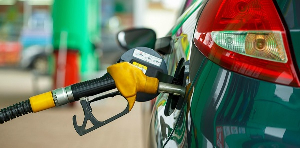
 File photo of a fuel pump
The Chamber of Oil Marketing Companies has averred that the collapse of peace efforts between the United States and Iran has left Ghana’s fuel market on edge, with continued uncertainty in the Middle East threatening fuel price stability.
The renewed confrontation between Washington and Tehran has revived fears of disruptions to global oil supply.
Markets remain volatile as investors watch closely for further military or diplomatic developments, stoking concerns over the outlook for crude oil prices and what that means for fuel-importing countries like Ghana.
Speaking on JoyNews' PM Express Business Edition on Thursday, July 6, 2026, COMAC CEO, Dr Riverson Oppong said the latest breakdown in ceasefire efforts came as no surprise, given that uncertainty has become the defining feature of the conflict.
"Personally, I wasn't shocked to hear the turnaround of the peace deal because we've lived within this uncertainty for the past months, and only Trump knows when he's going to ceasefire, or probably only Iran knows when they're actually going to ceasefire," he said.
He warned that this uncertainty continues to expose Ghana's downstream petroleum sector to significant risks, as fuel prices swing sharply on the back of international market movements.
He explained that the volatility ripples through the entire fuel supply chain, affecting both Oil Marketing Companies (OMCs) and Bulk Distribution Companies (BDCs).
According to him, rising prices are generally the easier scenario for industry players to manage, since higher costs can be passed on to consumers. Falling prices, on the other hand, create far more severe financial strain.
"As far as revenue is concerned, it is a bit easier when prices are moving up, but when prices are going down, it is a bit deadly, not only to the OMCs but to the BDCs as well," he said.
He noted that the biggest challenge arises when companies import fuel at higher prices, only for international prices to fall before the products reach the market.
"Imagine buying at a higher price within a window, and you wake up, and the next window price has gone down. You've knocked your price," he explained.
The COMAC CEO added that while hedging is often floated as a way to manage price risk, it isn't always practical for Ghana's retail fuel business.
His comments come as Ghana's petroleum industry keeps a close watch on developments in the Middle East, where renewed US-Iran tensions have added yet another layer of uncertainty to an already volatile global energy market.
For Ghana, which relies on imports of refined petroleum products, prolonged instability could keep influencing fuel pricing, squeezing industry margins and complicating planning for businesses across the downstream sector.
The CEO said that until there is greater clarity on the geopolitical situation, fuel marketers will have to keep operating in an environment where sudden price swings remain a constant risk.
DR/SA
Inside the AI revolution that could save lives on Ghana's roads

Copyright © 1994 - 2026 GhanaWeb. All rights reserved.










