



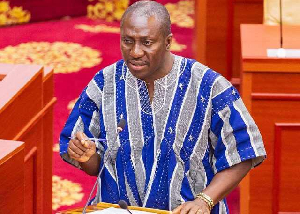
 Alexander Afenyo-Markin is the Minority Leader in Parliament
The Minority in Parliament staged a walkout during the consideration of the Tribunals Bill, 2026.
The Caucus abandoned proceedings on July 16, 2026, after accusing the Majority of refusing to engage in meaningful dialogue and using its numerical advantage to force the bill through despite objections from organised labour, legal stakeholders and recommendations from the Constitutional Review Committee.
Addressing journalists after the walkout, the Minority Leader, Alexander Kwamina Afenyo-Markin said the Caucus saw no need to remain in the chamber because it was evident that the Majority was not willing to consider opposing views.
"In Parliament, we believe that in all situations of disagreement, there must be a window to discuss, to raise the concerns. But once the Majority Leader makes a strong pronouncement that whatever the case, they will not listen, they will use their numbers to pass the bill, then there was no point again," he remarked.
Afenyo-Markin said any further attempt by the Minority to debate the bill would have proved futile.
"Every other effort will be rendered obnoxious. Every other effort by us will be rendered nocturnal," he stated.
According to the Member of Parliament for Effutu the proposed tribunal system could
Afenyo-Markin also argued that the proposed tribunal system could undermine due process and fair trial guarantees.
"This whole exercise is to create a system where people would be pronounced guilty even before their case is properly determined. No established procedure of ensuring fairness, and it is not only the Minority that is complaining," he said.
He cited Ghana's experience under the Provisional National Defence Council (PNDC), arguing that the country's tribunal system during that era should serve as a warning against reintroducing similar institutions.
"Tribunal system, we know what happened in the PNDC era where people were targeted, assets were seized and those people who claimed they were tribunal members enriched themselves. We know that record of the NDC, their predecessor PNDC," he stated.
The Minority Leader also questioned whether the Majority had the required quorum to proceed with the bill.
He indicated that the proceedings were suspended earlier in the day after realising there were not enough members in the chamber, before reconvening several hours later.
"You recall that earlier in the day when we raised this issue, the Majority Leader, realising that he didn't have the numbers, immediately called for suspension of the House," he said.
He claimed that even after the House resumed, the Majority still lacked the numbers it purported to have.
"So, he used the five hours to marshal his members into the chamber. Even so, those present were not even up to 115. They were 113," Afenyo-Markin alleged.
He challenged the media to independently verify the attendance figures.
"We the Minority counted them. They were not up to [the number]. Yet those who counted claim that the NDC members were more than that. You are the media. You can get in and do your own check to validate what we are saying. We tell you the truth. We will not say anything outside of the truth," he said.
Afenyo-Markin accused the Majority of refusing to heed to dissenting views.
"So, it is clear that the 'Yentie Obiaa' syndrome has set in, in this exercise," he said.
Despite the Minority's walkout, Parliament proceeded with the consideration of the Tribunals Bill, 2026, which seeks to establish a new legal framework for the constitution, composition, jurisdiction and administration of tribunals established under Article 126 of the 1992 Constitution.
The government has argued that the legislation is intended to modernise the tribunal system, improve access to justice and provide specialised adjudication for categories of cases assigned under the Constitution or by statute.
Why Minority is threatening court action over government's policies
However, sections of the legal fraternity, organised labour and governance advocates have urged Parliament to proceed cautiously, arguing that any tribunal system must safeguard constitutional guarantees of fair hearing, judicial independence and due process.
JKB/VPO
Mahama Ayariga speaks on Kwame Frimpong’s seat in Parliament

Copyright © 1994 - 2026 GhanaWeb. All rights reserved.










