



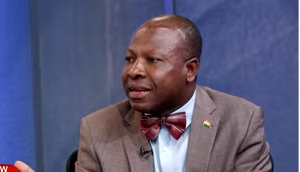
 Dr James Kwabena Bomfeh Jnr is CEO of the Centre for Constitutional Studies
Chief Executive Officer of the Centre for Constitutional Studies (CenCES), Dr James Kwabena Bomfeh Jnr, has criticised the Public Tribunals Bill, 2026, arguing that it seeks to revive a tribunal system that Ghana's constitutional reforms deliberately dismantled.
Speaking on JoyNews' Newsfile on July 18, 2026, Dr Bomfeh contended that the Bill ignores recommendations made by constitutional review bodies and undermines the spirit of the 1992 Constitution.
Referring to retired Supreme Court judge, Justice William Atuguba's recent comments during the 20th D F Annan Memorial Lecture, Dr Bomfeh said Members of Parliament should put the national interest above partisan considerations.
"This week, Parliament had the 20th DF Annan Memorial Lecture, and it was given by the revered retired jurist. Justice William Atuguba. He said something to the MPs, pointing to them that when he sees or watches or looks at Parliament, he sees something else, and that they are pursuing partisan, personal, self-aggrandizing, and not the interest of the state", he noted.
Dr Bomfeh argued that the Constitution only recognises regional tribunals under Article 142 and not an independent tribunal system.
Quoting the Constitution Review Commission report, he noted that the Committee of Experts that drafted the 1992 Constitution deliberately integrated public tribunals into the traditional court system to ensure they were subject to constitutional safeguards.
"For anybody to be under an illusion that there is the tribunal system in the Constitution is something I cannot understand. It doesn't exist," he said.
Dr Bomfeh further questioned the rationale behind the Bill, asking whether it was effectively attempting to amend Articles 142 and 143 of the Constitution without openly acknowledging it.
"Is this supposed to be amending Article 142 and 143 of the Constitution, 1992, and pretending about it; is it not?" he asked.
He also rejected the memorandum accompanying the Bill, which states that regional tribunals have become defunct in practice and that the legislation seeks to fill a gap in Ghana's legal framework.
"The memorandum admits this and yet goes ahead to say that the Tribunals Bill seeks, therefore, to address the lacuna in the legal framework of Ghana regarding tribunals. There is no lacuna, this is dishonesty", Dr Bomfeh stated.
He accused the government of disregarding recommendations made by the Constitution Review Commission chaired by the late Professor Albert Kwadwo Fiadjoe, as well as subsequent constitutional reform proposals.
According to him, the recommendations of experts who devoted years to reviewing Ghana's Constitution have been selectively implemented.
"Next time we are inviting people as experts to committees... would they be willing considering this?" he questioned.
Dr Bomfeh noted that the Constitution Review Commission undertook extensive nationwide consultations, visiting all districts at the time, holding dozens of public sessions and receiving more than 83,000 submissions before producing its report.
He also argued that the word "tribunal" still evokes painful memories for many Ghanaians because of the country's experience with public tribunals during previous regimes.
"When we hear the name tribunal, it sends shivers within the spines of people," he said.
While acknowledging that specialised tribunals currently exist under Ghanaian law, Bomfeh stressed that they operate within the established court system and under the Rules of Court, unlike the former public tribunal structure.
He further warned against introducing a system that could allow individuals without legal backgrounds to adjudicate cases.
"There are problems with our judicial and justice system. They include lack of resources. They include lack of personnel. They include lack of logistics... What will happen when we are introducing the likelihood of partisan people without any legal background?" he added.
According to Dr Bomfeh, the legislation risks reviving a system the framers of the 1992 Constitution intentionally moved away from.
Tribunals Bill: Lawyer details how a case dragged for 32 years
Parliament has passed the Tribunals Bill, 2026, despite opposition from the Minority Caucus.
The bill aims to improve access to justice and address delays in the court system by establishing a legal framework for tribunals.
JKB/VPO
Understanding Maternal Mental Health

Copyright © 1994 - 2026 GhanaWeb. All rights reserved.










