



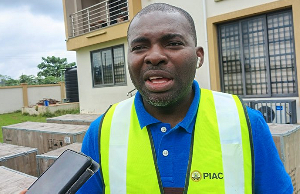
 Christopher Opoku Nyarko is a member of PIAC
The Public Interest and Accountability Committee (PIAC) has called on the government to directly involve Metropolitan, Municipal and District Assemblies (MMDAs) in oil and petroleum-funded projects in their jurisdictions to ensure proper supervision and value for money and holistic development.
Speaking to the media after a PIAC project inspection exercise in the Adansi area of the Ashanti Region, Christopher Opoku Nyarko, a Member of PIAC, said the Committee’s role is to ensure that revenues accrued from oil extraction are put to their best use and that the public is kept informed on how petroleum funds are utilized.
According to him, as part of their work programme, they are paying working visits to districts to provide additional oversight of the management and use of Ghana’s petroleum revenues.
He added that one way the revenue is used is through the Annual Budget Funding Amount, which is channeled through the Ministry of Finance to beneficiary communities.
He noted that they do follow-ups to see whether indeed the projects admitted in the budget have actually been executed. In the Adansi North District, the Committee inspected a school building and a police station.
Nyarko said the patching of potholes on the road from Adansi Asokwa to Obuasi was not satisfactory and had no value for the oil money injected into it, while the police station building was done well and had been completed.
He noted that some finishing works were still outstanding and that the police station had to rely on the district office for water connection.
On the school project, Nyarko observed that the building had no furniture, washrooms, or electricity -the basic facilities that the school children need to be able to work.
At Adansi Asokwa, the Committee inspected a staff bungalow and a Health Centre that were reportedly handed over in 2020 and operationalised in 2021.
He argued that the bungalow did not represent good use of our revenue because it was very small. Nyarko identified the lack of involvement of local Assemblies as the biggest challenge because most of these projects are decided in Accra and brought down to the districts.
The Health Centre funded with Oil and Petroleum at Adansi Asokwa He argued that the assemblies are not involved as such projects funded with oil and petroleum are often tagged as ‘MP’s project as officials at the Assembly are not aware that oil money had funded the projects.
Nyarko reiterated that the constitution envisages that regardless of where one is, one should benefit from the extraction of oil.
He also noted that supervision for these projects is very weak as the assemblies have not even captured these projects in their own reports and are regarded as non-existent.
According to him, the top-down approach does not support proper or holistic development and reaffirmed that PIAC is advocating stronger coordination between the Ministry of Finance and the Ministry of Local Government to improve planning and oversight of petroleum-funded projects.
He indicated that reports must go back to Parliament in an honourable manner so that the benefits of oil revenue can truly serve the entire country.
David Kunta, the Adansi Asokwa District Health Director, who received the Committee, thanked the government and PIAC for the facility provided through petroleum funds in 2021.
He said the facility was initially built to serve a smaller population, but demand has now increased and expansion is needed.
He mentioned a major challenge as the lack of laboratory services and appealed for a one-stop shop with a laboratory to enable pregnant women access healthcare without having to travel to other health facilities outside the district and want the facility to be.
He also appealed for support in fencing the facility to prevent encroachment, adding that while the facility has been useful since 2021, more investment is needed in 2026 to make it fully functional.

Copyright © 1994 - 2026 GhanaWeb. All rights reserved.










