



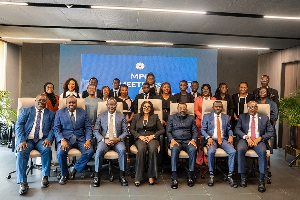
 University of Ghana students gain first-hand insight into BoG’s monetary policy decisions
Economics textbooks and handbooks are replete with information on the monetary policy processes of central banks and monetary authorities. Students of economics and related business disciplines, such as finance, encounter these concepts at various stages of their undergraduate and postgraduate studies.
However, classroom learning often provides only a theoretical foundation. Every four to six weeks, the Governor of the Bank of Ghana announces a policy rate decision, supported by extensive analysis of economic data and developments. While students may be familiar with this process, many do not get the opportunity to experience first-hand the rigorous work that informs such decisions.
This week, however, a select group of students from the University of Ghana had the opportunity to witness that process directly.
As part of the 131st Monetary Policy Committee (MPC) Meetings, the Bank of Ghana launched the inaugural Monetary Policy Committee Educational Observership Programme (MPC-EOP), an initiative aimed at deepening public understanding of monetary policy by providing students with practical exposure to the Bank’s policy formulation and communication processes.
The programme forms part of the Bank’s broader commitment to transparency, public engagement and strengthening policy credibility. Through the observership, students moved beyond theoretical learning to observe how economic evidence is gathered, analysed and debated before the Committee arrives at a policy decision.
The programme began with an orientation session introducing students to the Bank’s mandate, Ghana’s monetary policy framework and the role of the MPC. It then progressed to technical presentations that form the foundation of the Committee’s deliberations.
Students listened to Bank officials and invited experts provide detailed assessments of Ghana’s macroeconomic conditions, inflation trends, global economic developments, the external sector, financial markets, agriculture and broader real sector performance.
The presentations highlighted the depth of analysis required in monetary policy decision-making and demonstrated the wide range of economic indicators considered by the Committee.
For many participants, the experience challenged existing perceptions about how monetary policy decisions are made. One student said the programme dispelled the misconception that the Governor alone determines the Monetary Policy Rate.
“One misconception that was completely dismantled was the fact that every time we see the Governor on the news announcing the policy rate, we assumed he had made that decision on his own,” the student said while addressing the Governor and members of the Committee.
“What we have observed shows that the decision is the result of thorough analysis, careful discussion and contributions from many experts.”
The student described the programme as an opportunity to “practicalise what we are learning,” noting that the presentations had transformed classroom theories into real-life policymaking experiences.
Beyond improving understanding of monetary policy, the initiative encouraged students to think more broadly about economic issues. Discussions on agriculture, inflation dynamics, external shocks and financial conditions generated new research ideas and demonstrated how developments across various sectors influence monetary policy decisions.
Speaking during the opening session of the 131st MPC Meetings, Governor Dr Johnson Pandit Asiama described the initiative as an important step in the Bank’s commitment to transparency and public engagement.
“Monetary policy is most effective when it is understood, trusted and supported by the public,” he said.
“Through this initiative, we seek to demystify the monetary policy process by providing students with practical exposure to the analytical work, technical discussions and communication processes that underpin the Committee’s decisions.”
The Governor noted that the programme forms part of broader efforts to strengthen policy credibility while building stronger links between academia and public policy institutions.
The observership extends beyond technical discussions, as participants will also witness the MPC Press Briefing, where the Committee’s policy decision is communicated to the public and the media. Students will also engage the Governor in a special post-MPC discussion aimed at explaining the policy decision in simple and practical terms.
Faculty members accompanying the students welcomed the initiative, describing it as an important bridge between academic learning and public policy practice.
The positive response has also generated discussions on expanding the programme to include students from other tertiary institutions across the country, reinforcing the Bank’s commitment to promoting economic literacy and strengthening understanding of monetary policy among future economists, researchers and policymakers.
As the inaugural cohort continues its observership, one thing has become clear: the Monetary Policy Committee is far more than the announcement of a policy rate. It is a rigorous process built on evidence, analysis, debate and accountability.
By opening aspects of that process to students, the Bank of Ghana is not only strengthening transparency but also inspiring the next generation of economists to better understand the institution responsible for maintaining price stability and supporting Ghana’s economic development.


Copyright © 1994 - 2026 GhanaWeb. All rights reserved.










