



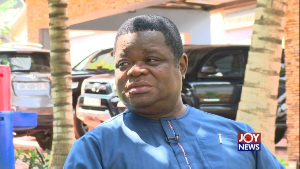
 Professor Peter Quartey is the Former Director of ISSER
Former Director of the Institute of Statistical, Social and Economic Research (ISSER), Professor Peter Quartey, has called on Finance Minister Dr Cassiel Ato Forson to use the 2026 Mid-Year Budget Review to announce bold measures that will boost domestic revenue while channelling more investment into infrastructure, agriculture and manufacturing to create sustainable jobs.
According to him, although Ghana has made significant progress in restoring macroeconomic stability, the country's economic recovery must now translate into employment opportunities and increased productivity.
Prioritise MMDAs like Eurobond payments – Prof Quartey tells government
Speaking on JoyNews' AM Show ahead of the Finance Minister's presentation to Parliament on Thursday, July 23, 2026, Prof Quartey said government spending should focus on sectors capable of driving long-term economic transformation.
He identified agriculture and manufacturing as the backbone of Ghana's economy, stressing that both sectors have the greatest potential to create jobs if they receive the necessary investment and policy support.
"But one area has to do with our real sector, manufacturing and agriculture. I think that's where I want to see the injection.
"But those are the two key areas that create jobs, that create the most jobs. So what incentives are we providing to the private sector? That's where the injection should go," he said.
Prof Quartey also urged the government to introduce policies that encourage private sector participation while strengthening agricultural value chains to improve productivity and reduce Ghana's dependence on imported food.
He stressed that expanding irrigation infrastructure should be a priority, arguing that agriculture cannot thrive without reliable access to water.
"If we want to see agriculture flourish, to what extent are we providing the infrastructure, the enabling environment for irrigation, for instance?" he questioned.
Expressing concern over Ghana's growing food imports, the economist said neighbouring countries are making better use of irrigation despite having fewer natural advantages.
"It's a shame that we go to Burkina Faso, who are irrigating its tomato and other food production, and then we import onions from other countries. We tend to import more from these countries than we can do in our own country," he lamented.
Prof Quartey further called for increased support for farmers across the agricultural value chain, describing investments in irrigation, production and farmer assistance as critical to improving food security.
While welcoming the government's renewed focus on revitalising the poultry industry, he said implementation challenges must be addressed if the initiative is to achieve its intended impact.
"We've seen the move towards poultry. I think that is good, but the implementation is poorly handled," he said.
He urged the government to engage major poultry farmers to identify and resolve the sector's challenges.
"We should try to engage the poultry farmers, the big poultry farmers, and try to correct the wrong as quickly as possible," he advised.
On infrastructure, Prof Quartey praised the government's flagship Big Push programme but said its implementation has been slower than expected.
"Well, the Big Push is great, I think, honestly. But it is not moving at a pace that I would have expected.
"So yes, the Big Push is good, but I think we want to see some rapid injection into the sector. I want to see better roads as quickly as possible," he stated.
Beyond agriculture and infrastructure, the economist also highlighted sanitation as a key area that deserves sustained investment, arguing that improved public services are essential for inclusive economic growth.
NA/VPO
HEALTH FOCUS: What every mother should know about maternal mental health

Copyright © 1994 - 2026 GhanaWeb. All rights reserved.










