



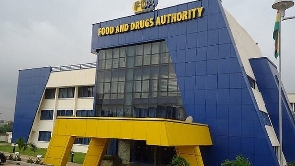
 Entrance of Food and Drugs Authority
Many businesses in Ghana continue to operate without licences, with some failing to register their facilities with the Food and Drugs Authority (FDA) as required by law.
While a few maintain hygienic standards, others focus solely on production and profit, disregarding regulatory obligations.
Under the Public Health Act, 2012 (Act 851), business owners are mandated to register their facilities with the FDA before producing food products.
According to the Head of Communications at FDA, Rhoda Appiah, registration fees are modest; less than GH¢300 for small‑scale businesses and GH¢600 for large‑scale operations.
"The law requires FDA to be able to register facilities before they will be able to produce any food products. Section 130 of the Public Health Act 2012 (Act 851) gives that provision...it does not cost you that much to apply for the registration of your facility. Even for large scale businesses, it is just GH¢600," Rhoda Appiah said.
Why Ato Forson is not spending
Failure to register can lead to temporary closure, product seizures, and administrative charges of up to GH¢30,000.
Rhoda Appiah urged consumers to buy only FDA‑approved products and check labels for valid registration numbers.
Her comments follows the FDA’s closure of two unlicensed sachet water facilities and a cold store in Greater Accra after inspectors uncovered serious hygiene breaches.
The enforcement exercise, carried out on Wednesday, is part of a nationwide campaign.
Over the past two weeks, the FDA has shut down 59 food manufacturing and cold storage facilities, including 44 food producers and more than 15 cold stores.
Inspectors found sachet water being produced with untreated, algae‑contaminated water, poor storage conditions, and facilities lacking ultraviolet (UV) sterilisation systems, resulting in unsafe products reaching consumers.
SA
Inside the AI revolution that could save lives on Ghana's roads

Copyright © 1994 - 2026 GhanaWeb. All rights reserved.










