



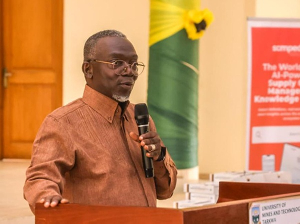
 Professor Douglas Boateng is a Ghanaian engineer, founder and scriber of NyansaKasa
On July 15, 2026, a day that will be recorded in the annals of African intellectual achievement, the University of Mines and Technology joined Ing. Professor Douglas K Boateng to launch the world's first Artificial Intelligence-powered Supply Chain Management Compendium, an innovation solely conceived, developed, and delivered by Professor Boateng that redefines how supply chain knowledge is created, accessed and applied across the globe.
The platform, which transforms the world's only dedicated Supply Chain Management Compendium, first published in South Africa by Professor Boateng in 2013 with support from industrial giants including SASOL and Transnet, into a living, conversational and continuously evolving intelligence ecosystem, was born of a conviction that has driven Professor Boateng's career across three decades of boardrooms, lecture halls and national policy tables: that supply chain knowledge must be accessible to everyone, everywhere, without exception.
Not to the privileged few at well-resourced institutions in the developed world, but to the student in Tarkwa and the procurement officer in Nairobi, with the same urgency and depth as to the researcher in London or New York.
Users of the platform no longer search for knowledge. They engage with it, challenge it, and build upon it in real time, drawing on thousands of curated supply chain concepts, frameworks, principles, and real-world applications through natural language conversation. It is, as Professor Boateng describes it, not a revision of what existed but a reinvention of what is possible.
For Professor Boateng, the significance of the moment extends well beyond technology. “Artificial intelligence is not replacing knowledge,” he said at the launch. “It is democratising it. This is not merely an innovation for Ghana. It is a contribution from Africa to the world.”
That declaration resonated through an event that brought together academics, industry leaders, government representatives, and supply chain professionals to witness a milestone that few had imagined possible from the African continent at this scale and with this ambition.
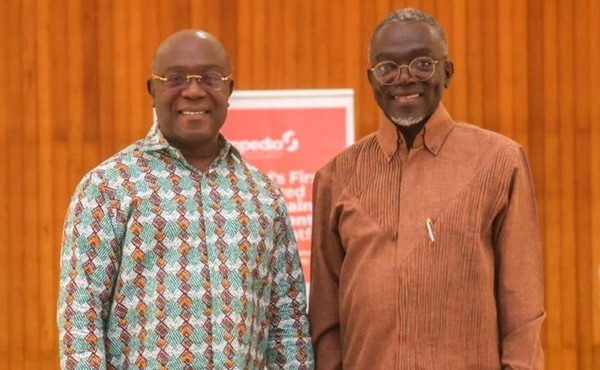
Professor Richard Amankwah, Vice Chancellor of UMaT, spoke to the deeper institutional significance of what the collaboration represents.
“UMaT is not merely collaborating in the launch of an academic resource,” he said.
“We are helping to demonstrate that African universities and African scholars can lead global innovation. Professor Boateng's achievement redefines how specialised knowledge will be created, accessed, and applied in the age of artificial intelligence.”
Geography no longer determines the quality of knowledge available. That is not an aspiration. It is now a reality
The implications stretch far beyond the academy. Supply chain management is the operational backbone of every service a government delivers, every product a manufacturer produces, every hospital that receives medicines on time, and every infrastructure project that must procure materials and deliver outcomes within budget.
For years, the professionals responsible for those decisions across Africa have operated with inadequate access to the depth of knowledge their roles demand. The AI-powered Compendium addresses that deficit at its root.
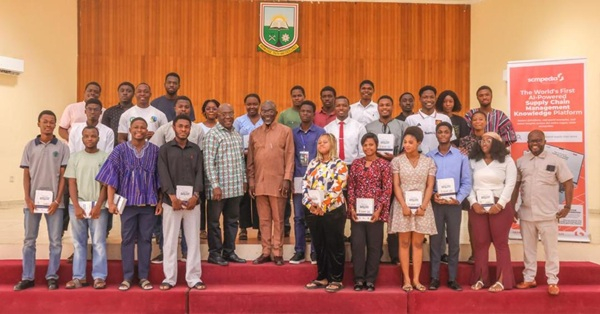
Public sector procurement officers, healthcare supply chain managers, infrastructure project teams, and private sector enterprises can now access, instantly and conversationally, the authoritative knowledge required to deliver better outcomes at lower cost and with greater accountability.
Academics, students, and curriculum developers draw on an unparalleled, continuously updated knowledge repository that keeps teaching aligned with the rapidly evolving demands of global supply chains.
For continuous professional development, boardroom decision-making, tender preparation, and policy formulation, the platform provides the kind of immediate, practically actionable intelligence that previously required weeks of research or expensive external consultancy.
The industrialisation implications are equally compelling. Conceived, built, and launched in Ghana on the African continent, the platform directly supports the ambitions of the African Continental Free Trade Area, local content programmes, and value chain integration strategies across the sub-region.
When supply chain professionals across Africa share a common understanding and a common nomenclature, the effects compound across every sector: collaboration deepens, standards rise, industries strengthen, and nations compete more effectively on the global stage.
For a continent whose industrialisation agenda has long been hampered by fragmented knowledge and inconsistent professional practice, that shared foundation is not a marginal benefit. It is a structural shift.
Africa has not waited to be invited to lead global knowledge development. It has chosen to lead
What makes the launch remarkable is not only what has been created but where it has been created. The platform was conceived in South Africa and developed solely in Ghana, and will now serve governments, multinational corporations, development agencies, logistics providers, manufacturers, and entrepreneurs worldwide.
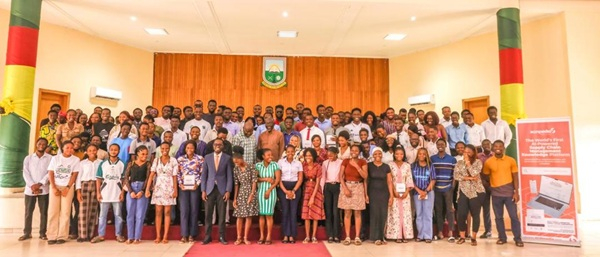
It is a global resource with an African origin, and it carries a message that the global technology community would do well to note: the next wave of transformative knowledge platforms will not come only from Silicon Valley or the research universities of Europe. It will come from wherever the combination of expertise, ambition, and intellectual rigour is sufficient to produce something the world has never seen before.
As artificial intelligence continues to reshape every economy and every profession, the launch of the world's first AI-powered Supply Chain Management Compendium is an unambiguous declaration of continental intent.
Africa is not a spectator in the Fourth Industrial Revolution. Through the scholarship of Ing Professor Douglas K Boateng and the collaborative institutional platform of the University of Mines and Technology, it is helping to write the revolution's next chapter.

Copyright © 1994 - 2026 GhanaWeb. All rights reserved.










