



 Bernard Antwi Boasiako, aka Chairman Wontumi, is th NPP Ashanti Regional Chairman
The Ashanti Regional Chairman of the New Patriotic Party (NPP), Bernard Antwi Boasiako, aka Chairman Wontumi, has reportedly filed an appeal challenging his recent conviction and 20-year sentence in the illegal transfer of a mining licence case.
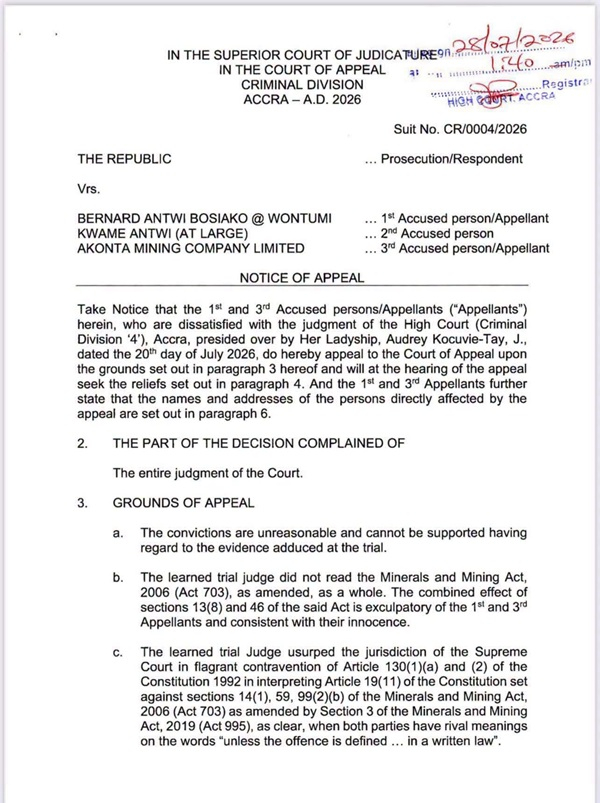
Excerpts of the notice of appeal, which was reportedly filed by Wontumi's lead counsel, Samuel Atta Akyea, and sighted by GhanaWeb, showed that both Wontumi, the first accused in the case, and his company, Akonta Mining Company Limited, the third accused in the case, are challenging the court's ruling.
It was stated in the notice that the two applicants were dissatisfied with the judgement of the trial judge, Justice Audrey Kocuvie-Tay.
“Take Notice that the 1st and 3rd Accused persons/Appellants ("Appellants") herein, who are dissatisfied with the judgment of the High Court (Criminal Division '4'), Accra, presided over by Her Ladyship Audrey Kocuvie-Tay, J., dated the 20th day of July 2026, do hereby appeal to the Court of Appeal upon the grounds set out in paragraph 3 hereof and will, at the hearing of the appeal, seek the reliefs set out in paragraph 4. And the 1st and 3rd Appellants further state that the names and addresses of the persons directly affected by the appeal are set out in paragraph 6,” part of the court document, which was dated July 28, 2026, read.
The lawyers for Wontumi raised 20 grounds of appeal, including their claim that the judgement was unreasonable and unsupported by the evidence on record.
They also argued that the judge did not properly apply the mining law, adding that she also usurped the jurisdiction of the Supreme Court.
“GROUNDS OF APPEAL
a. The convictions are unreasonable and cannot be supported having regard to the evidence adduced at the trial.
b. The learned trial judge did not read the Minerals and Mining Act, 2006 (Act 703), as amended, as a whole. The combined effect of sections 13(8) and 46 of the said Act is exculpatory of the 1st and 3rd Appellants and consistent with their innocence.
c. The learned trial Judge usurped the jurisdiction of the Supreme Court in flagrant contravention of Article 130(1)(a) and (2) of the 1992 Constitution in interpreting Article 19 of the Constitution against sections 14(1), 59 and 99(2)(b) of the Minerals and Mining Act, 2006 (Act 703), as amended, and section 3 of the Minerals and Mining Act, 2019 (Act 995), as clear, when both parties have rival meanings of the words ‘unless the offence is defined.... in a written law’,” the document further stated.
Chairman Wontumi jailed for 20 years
Below are some of the grounds for appeal:
The learned counsel argues that the conviction is unreasonable and unsupported by the evidence on record.
Counsel contends that the trial court misconstrued key provisions of the law relating to mineral rights and mining operations.
Counsel further contends that the trial court usurped the jurisdiction of the Supreme Court in determining the constitutionality of certain statutory provisions.
Counsel challenges the reliance placed on the testimony of PW2, whom the defence characterises as a self-confessed illegal miner and participant in the alleged enterprise.
The appeal argues that the circumstantial evidence did not irresistibly point to guilt and that reasonable alternative explanations existed.
Counsel contends that there was no evidence establishing the requisite mens rea (criminal intent) for the offences.
The learned counsel argues that the lifting of the corporate veil to convict the 3rd Appellant is legally unsustainable.
Counsel contends that exculpatory evidence was disregarded or insufficiently considered.
The appeal argues that the sentences imposed are inordinately harsh and excessive.
BAI
AROUND TOWN: Are Toyota Voxy vehicles fit for Ghana’s roads?

Copyright © 1994 - 2026 GhanaWeb. All rights reserved.










