



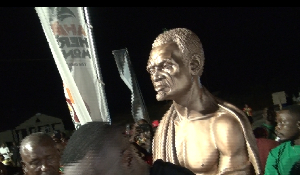
 The statue of King Badu Bonsu II
The Ahanta people on Monday, July 27, 2026, commemorated one of the most significant moments in their history with the unveiling of a historic statue in honour of King Badu Bonsu II, exactly 180 years after the revered monarch was executed by Dutch colonial authorities.
The solemn yet colourful ceremony, held at Agona Nkwanta in the Ahanta West Municipality of the Western Region, formed a major highlight of the maiden Ahanta Heritage Month celebrations and attracted traditional rulers, Members of Parliament, ministers of state, members of the diplomatic corps and hundreds of residents.
The event blended celebration with deep reflection as the Ahanta people remembered the courage, resilience and resistance of King Badu Bonsu II, who fought against Dutch colonial domination in the Ahanta enclave.
In a symbolic display of remembrance, traditional leaders led residents in a candlelight procession before jointly unveiling the monument dedicated to the late king, whose sacrifice has remained a defining chapter in the history of the Ahanta Kingdom.
The ceremony coincided with the 180th anniversary of the execution of King Badu Bonsu II by the Dutch after a bitter conflict with the colonial administration.
Historical records indicate that the Ahanta ruler was executed by the Dutch for resisting colonial rule and obnoxious treaties.
His death became one of the darkest moments in the history of the Ahanta people, with consequences that have echoed across generations.
Following his execution, his head was severed and transported to the Netherlands, where it remained preserved in a jar of formaldehyde at the Leiden University Medical Centre for well over a century after arriving there in the late 1830s.
The tragic episode has since become a powerful symbol of colonial injustice and the struggle for dignity and self-determination among the Ahanta people.
The monument was spearheaded by the Member of Parliament for Ahanta West, Mavis Kuukua Bissue, as part of efforts to preserve the history and cultural identity of the Ahanta Kingdom through the maiden Heritage Month celebrations.
Speaking to journalists after the unveiling, Madam Bissue described the occasion as far more than a cultural festival.
She said it represented “a moment of reckoning” for the Ahanta people to reflect on their shared history, identity and collective future.
The lawmaker appealed passionately for unity among the people, urging traditional leaders, the youth and members of the Ahanta diaspora to work together to preserve their rich cultural heritage while pursuing sustainable development.
According to her, the greatest threat confronting the Ahanta people today is no longer external aggression but internal divisions.
She cautioned that throughout history, kingdoms had not collapsed because their people loved one another too much, but because mistrust, pride and personal interests often replaced unity and the pursuit of the common good.
Bissue therefore called on traditional leaders to embrace reconciliation and heal longstanding divisions, stressing that a united traditional front would inspire investor confidence, create hope for the youth and accelerate socio-economic development across the Ahanta area.
She also encouraged young people to remain proud of their identity and cultural heritage while embracing education, innovation and modern opportunities.
The Chief of Agona Nkwanta and Tufuhen of the Ahanta Traditional Council, Nana Eziaku IV, praised Madam Bissue for championing initiatives aimed at preserving and promoting Ahanta history and culture.
He described the unveiling of the statue as a historic milestone that would serve as a lasting reminder of King Badu Bonsu II’s sacrifice and a symbol of unity among the Ahanta people.
According to the traditional leader, the monument should inspire future generations to remain united and continue protecting the values and heritage handed down by their ancestors.
The unveiling of the statue marked one of the defining moments of the maiden Ahanta Heritage Month celebrations, reinforcing renewed calls for cultural preservation, reconciliation and collective development while immortalising the memory of King Badu Bonsu II, whose resistance against colonial oppression continues to inspire the Ahanta people 180 years after his death.

Copyright © 1994 - 2026 GhanaWeb. All rights reserved.










