



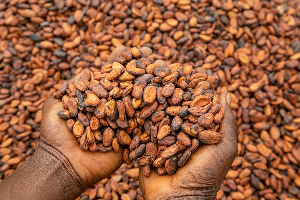
 File photo of cocoa beans
Ghana’s cocoa export earnings could weaken in the 2026/27 season as international prices retreat from recent highs and domestic production is projected to fall by at least 16 percent, putting pressure on one of the country’s major sources of foreign-exchange receipts.
Cocoa export earnings nearly doubled to US$3.86 billion in 2025 from US$1.94 billion in 2024, according to Bank of Ghana data, supported by improved export volumes and higher international prices.
The gains in cocoa receipts are now under pressure from falling world market prices and a weaker production outlook for the 2026/27 crop season, which begins in September.
COCOBOD expects Ghana’s 2026/27 crop to fall by at least 16 percent, citing adverse weather, the production cycle of cocoa trees, disease and pressure on cocoa-growing land.
More recent market estimates put production at between 450,000 and 550,000 tonnes, compared with about 750,000 tonnes in the 2025/26 season. At those levels, Ghana could produce between 200,000 and 300,000 tonnes less cocoa next season.
The expected decline comes as international prices have retreated sharply from their previous highs.
COCOBOD said in February that the world market price had fallen from an average of about US$7,200 per tonne to US$4,100 per tonne, reducing the value of cocoa sales and creating liquidity pressure within the purchasing system.
Government subsequently reduced the producer price for the remainder of the 2025/26 season to GH¢41,392 per tonne, or GH¢2,587 per 64-kilogram bag, from GH¢58,000 per tonne.
COCOBOD said the adjustment reflected the decline in international prices and the need to keep Ghanaian cocoa competitive on the international market. Government maintained the GH¢41,392-per-tonne price for the light crop beginning in June.
International prices have remained volatile. New York cocoa futures rose sharply earlier this month after Ghana’s weaker production outlook renewed concerns over West African supply, before coming under fresh pressure as expectations of improved growing conditions weighed on the market.
The combination of lower prices and weaker production could reduce one of Ghana’s major sources of foreign-exchange earnings.
Bank of Ghana data show cocoa beans and processed products generated US$3.86 billion in 2025, with cocoa beans contributing US$2.10 billion and processed cocoa products about US$1.76 billion.
The increase in cocoa receipts contributed to Ghana’s stronger merchandise trade position alongside higher gold earnings. A decline in cocoa receipts would reduce the sector’s contribution to export inflows even as gold continues to dominate the country’s export basket.
Production pressures are particularly pronounced in the Western and Western North regions, which account for more than half of Ghana’s cocoa output.
Excessive rainfall in May and June and a lower number of surviving young pods have weakened the crop outlook, according to COCOBOD. Swollen shoot disease, ageing farms and the loss of cocoa-growing land to illegal mining continue to weigh on production.
COCOBOD has responded with farm rehabilitation, expanded insecticide and fungicide spraying and the return of nationwide free fertiliser distribution for the 2026/27 season.
The expected decline would interrupt the recovery recorded during the current crop year. Ghana’s 2025/26 harvest is estimated at about 750,000 tonnes, up 25.6 percent from roughly 597,000 tonnes in 2024/25.
The regulator said earlier this year that the cost of purchasing and moving cocoa from farms to the port had reached about US$6,400 per tonne, exceeding prevailing international prices at the time and creating liquidity difficulties.
COCOBOD has since announced measures to reduce operating costs and reform the financing of cocoa purchases as it seeks to improve the financial position of the sector.
The outlook now leaves Ghana exposed to both weaker prices and lower export volumes in 2026/27. A recovery in international prices could offset part of the expected production decline, but continued weakness would reduce the value of cocoa shipments.
With output potentially falling by 200,000 to 300,000 tonnesfrom the current season and international prices substantially below earlier highs, Ghana’s US$3.86 billion cocoa export recovery faces a tougher 2026/27 season, with the final earnings outturn dependent on both production volumes and world market prices.

Copyright © 1994 - 2026 GhanaWeb. All rights reserved.










