



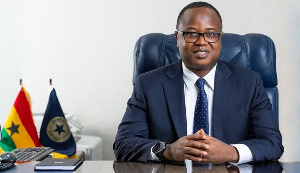
 Dr Maxwell Opoku-Afari is a former Bank of Ghana First Deputy Governor
Ghana’s increasing reliance on domestic borrowing did not eliminate its exposure to financial risks but instead created new vulnerabilities involving banks, investors and the exchange rate, former Bank of Ghana First Deputy Governor Dr Maxwell Opoku-Afari has said.
In a policy note titled “How Not to Miss a Crisis: Lessons from Ghana,” Dr Opoku-Afari argues that the shift towards cedi-denominated debt was initially viewed as a strategy to reduce exposure to foreign exchange risks and strengthen the domestic capital market.
However, he says the strategy ultimately deepened the link between government debt and the domestic financial sector.
The report describes this relationship as a sovereign-bank “doom loop”, in which banks become heavily exposed to government securities, while weaknesses in the financial sector can, in turn, create additional pressure on government finances.
Ghana's 2022 debt crisis was predictable, not sudden – Dr Opoku-Afari
“Domestic borrowing was politically appealing because it was perceived to reduce exposure to exchange-rate risk and to avoid external conditionality,” the report states.
“In practice, however, exchange-rate vulnerabilities persisted through sizable non-resident participation in domestic debt markets,” it added.
According to Dr Opoku-Afari, domestic debt rose from about 31% of GDP in 2019 to more than 40% in 2020 and 2021.
At the same time, banks, pension funds and insurance companies became major holders of government securities.
By the end of 2021, more than 30% of Ghana’s domestic debt was held on banks’ balance sheets, according to the report.
The former BoG First Deputy Governor said this created significant risks when confidence in the government’s finances deteriorated.
The report also notes that non-resident investors had become important participants in Ghana’s domestic bond market, with their holdings reaching 38.5% of total domestic instruments in 2017.
However, foreign investors began exiting as fiscal and external imbalances worsened and the COVID-19 shock hit.
Dr Opoku-Afari said these developments exposed the weakness of treating domestic-currency debt as inherently safer than external debt.
“This shift towards domestic debt was often seen as positive ‘de-dollarization’,” the report states, but adds that increased non-resident holdings blurred the distinction between domestic and exchange-rate risks.
Debt restructuring exposed vulnerabilities
The consequences became particularly severe during Ghana’s Domestic Debt Exchange Programme, which weakened the capital and liquidity positions of banks.
Dr Opoku-Afari therefore recommends stronger limits on banks’ holdings of government securities, alongside regular stress tests to assess how rising domestic interest rates and losses on government bonds could affect both banks and public finances.
He argues that debt sustainability assessments must go beyond the size of government debt to consider who holds the debt, its cost, refinancing requirements, and the extent to which financial-sector risks can feed back into government finances.
MA
'Deliberate attempt to undermine A-G' - Gyamfi jabs Afenyo-Markin over GoldBod claims

Copyright © 1994 - 2026 GhanaWeb. All rights reserved.










