



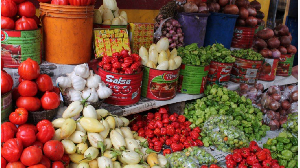
 Photo of foodstuff
Ghana's heavy spending on food production programmes has failed to reduce food inflation significantly, Economist, Dr Ishmael Yamson has said.
According to him, programmes such as Planting for Food and Jobs received millions of cedis, but food prices remained a major source of inflation in the country.
“We spent millions of money on Planting for Food and Jobs, right? And yet, food inflation never responded,” he said on Joy News.
According to him, the situation shows that Ghana needs to move away from short-term measures and invest in projects that can address food production challenges over many years.
Ghana loses millions as raw shea nut exports rise
Dr Yamson stated that food has always been a major part of Ghana's inflation problem, making long-term investment in agriculture important for keeping prices stable.
He pointed to the government's plan to invest in about 250,000 hectares of oil palm plantations, with part of the land expected to support food production, as an example of a longer-term approach.
"If the government says, I'm going to invest in 250,000 hectares for oil palm plantations, and part of it will be for food production in plantation form, you are resolving a very fundamental issue on a long-term basis," the economist mentioned.
He said Ghana must build strong systems to protect the economy instead of relying mainly on short-term interventions.
He also acknowledged the economic stability recorded by the government over its first 18 months in office but said maintaining the gains would require stronger economic structures.
Dr Ishmael Yamson added that efforts to build Ghana's foreign exchange reserves are another area that could support long-term economic stability.
According to him, although the Gold for Reserves programme comes with risks, achieving 15 months of import cover by 2028 could strengthen the country's ability to deal with future economic shocks.
Exporters push for faster product registration
Dr Yamson said Ghana also needs to maintain economic stability for a longer period to attract serious investors.
"I believe that unless we can demonstrate to investors that we can maintain stability for a minimum of 10 years, we will go nowhere," he stated.
He explained that investors who establish factories and create jobs often plan for 30 or 40 years and therefore need confidence that Ghana's economy will remain stable beyond a four-year political cycle.
DR/SA
Noise Maker, Palm Wine Bar Talk, Prison in His Brain: Sammy Gyamfi tears into Afenyo-Markin

Copyright © 1994 - 2026 GhanaWeb. All rights reserved.










