



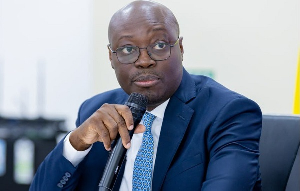
 Dr Cassiel Ato Forson is the Minister of Finance
Minister of Finance, Dr Cassiel Ato Forson, has declared that Africa’s quest to build a battery and clean energy industrial base will fail unless the continent abandons its raw export model and fixes its macroeconomic fundamentals.
Dr Forson made the remarks at the 2026 Future of Energy Conference (FEC), organised by the Africa Centre for Energy Policy (ACEP) in Accra, where energy leaders, policymakers and investors are meeting under the theme of managing Africa’s extractive future in the energy transition.
Speaking on the link between energy and industrialisation, the Minister said the continent’s ambition to import less and produce more, including batteries for electric vehicles and energy storage, requires a complete shift in mindset.
“To import batteries, this must change. Africa must move from raw exports to high-value production,” he said.
According to him, that transformation begins with stability. He listed the familiar hurdles that have constrained African industry, including inflation, which raises costs; volatile exchange rates, which undermine investor confidence; high interest rates, which constrain enterprises; unsustainable debt, which crowds out private financing; and fiscal indiscipline, which ultimately becomes everyone’s burden.
“Macroeconomic stability is therefore not separate from industrial policy; it is indeed the foundation,” Dr Forson stressed.
He pointed to Ghana’s recent turnaround as proof that the foundation can be laid.
Inflation, he said, fell from 23.8 per cent at the end of 2024 to 4.6 per cent in July 2026.
Government to regulate EV charging stations
The economy, which has struggled in previous years, grew by 6.0 per cent in 2025 and 6.4 per cent in the first quarter of 2026. External buffers have strengthened, while interest rates have declined.
“But stability is obviously not the destination; it is the launchpad for transformation,” he said.
From that launchpad, Dr Forson said Africa must confront its energy poverty head-on. About 600 million Africans still lack access to electricity, yet the continent attracts only around 2 per cent of global clean energy investment.
“We cannot industrialise a continent the world considers too risky to power,” he told participants.
The solution, he argued, lies in making energy investment work through efficient utilities, predictable regulation and credible opportunities for private investors.
He disclosed that Ghana is acting on that front by building a state-owned 1,200-megawatt gas-fired power plant to provide reliable and affordable baseload power for industry.
Even with power plants, the Minister warned that projects will stall without long-term financing.
In 2025 alone, Africa’s debt service costs were equivalent to more than 85 per cent of the continent’s total energy investment. Public budgets alone, he said, cannot carry the burden.
“We need guarantees, blended finance, local currency funding, deeper capital markets and credible public-private partnerships,” he said.
“But that finance must be affordable, and it must build industries, not simply fund extractives.”
For Dr Forson, the real value of the energy transition lies not simply in extracting lithium, manganese or graphite, but in processing, refining, manufacturing, technology, skills and job creation.
“Our resources must become industrial inputs,” he said.
“We must not replace fossil fuel exports with raw mineral exports and call it transformation, because that is not transformation.”
He called for Africa to industrialise as one market rather than as 54 fragmented economies.
The African Continental Free Trade Area (AfCFTA), he said, gives the continent leverage, but an agreement alone does not create trade.
“We must move from trading what we produce to producing what Africa trades in,” he said.
Ghana’s two-phase strategy
Outlining Ghana’s path, the Finance Minister described a clear two-phase strategy.
Stability was phase one, he said, a phase Ghana had now achieved through fiscal discipline and tight monetary coordination. Transformation, he said, would be phase two.
“For Ghana, stability was phase one, but transformation will certainly be our phase two. We have created a condition for private investment to build enterprises. Together, we must create jobs,” he said.
He ended with a call to action that drew applause from the audience.
“The resources are here in Africa; the market is with us; the people of Africa are ready. Let us turn Africa’s potential into production, production into jobs, and jobs into prosperity. That is all that Africa needs, and that is what we call transformation,” Dr Forson said.
The 2026 FEC, organised by ACEP in partnership with the Natural Resource Governance Institute (NRGI) and GIZ, continues in Accra with the AFREIKH Summer School and Innovation Challenge sessions focused on battery value chains, critical minerals and energy storage.

Copyright © 1994 - 2026 GhanaWeb. All rights reserved.










