



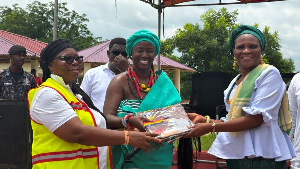
 Some farmers have ben empowered by CIKOD
The Centre for Indigenous Knowledge and Organisational Development (CIKOD), in partnership with the Lawra Municipal Assembly, Global Shea Alliance and Green Gold Savannah, has launched a Shea Enrichment Planting Initiative to restore degraded shea landscapes and strengthen livelihoods in the Upper West Region.
The initiative, launched on Friday, August 21, 2026, at the Farmer Managed Natural Regeneration (FMNR) Conservation Site at Pavuu, seeks to complement natural regeneration by enriching existing shea parklands with trees of ecological, cultural and economic value.
The launch brought together traditional authorities, government officials, farmers, shea collectors, women and youth groups, development partners and community leaders.
Here's how much a coconut seller in Accra earns on average
Speaking at the event, the Executive Director of CIKOD said the initiative was not simply about planting seedlings but building on restoration gains already achieved by the people of Pavuu.
He said the site, which was severely degraded more than a decade ago, had experienced significant regeneration through community commitment, indigenous knowledge and the FMNR approach.
According to him, FMNR combines ecological restoration with local governance, requiring communities to protect trees, manage bushfires, control livestock and establish mechanisms to share benefits from natural resources.
He cited findings from an Economics of Land Degradation study indicating that FMNR, when combined with appropriate farming practices, could increase cropland productivity by at least 83 per cent within five years under the conditions studied.
He said the evidence demonstrated that landscape restoration should be viewed as an economic investment rather than a cost.
The Executive Director said shea was deliberately selected because of its importance to food security, household income, culture, biodiversity and livelihoods across northern Ghana.
The Upper West Regional Minister, Charles Lwanga Puozuing, whose speech was delivered by his representative, Pognaa Fati Koray, described the initiative as an investment in the future of the region.
He said the shea tree was an economic asset and an important source of income and employment, particularly for women, but was increasingly threatened by bushfires, indiscriminate tree felling, land degradation, agricultural expansion and climate change.
He urged stakeholders to focus not only on planting trees but also on ensuring their survival and maturity.
“The real measure of success is not the number of seedlings distributed; it is the number that survive, mature and generate benefits for communities,” he said.
The Minister called for increased investment in shea processing, quality standards, packaging, cosmetics, food products and export markets to create greater economic value within the region.
He also urged Municipal and District Assemblies to support community nurseries, strengthen extension services, promote fire prevention and support women-led shea processing enterprises.
5 African business giants who stepped back from their companies
He further called for closer collaboration among CIKOD, the Tree Crops Development Authority, the Ministry of Food and Agriculture, the Forestry Commission, traditional authorities and development partners to transform the initiative into a sustained regional programme.
The CIKOD Executive Director said the initiative would be expanded beyond Pavuu to other degraded landscapes in the Upper West Region and eventually other parts of Ghana.
He called for long-term financing and policies that recognise communities as custodians of natural resources.
“May the trees we plant today grow beyond us. May they provide shade, food, income and ecological protection for generations to come,” he said.
DR/MA
Ghana will not borrow simply because financing is available – Dr Ato Forson

Copyright © 1994 - 2026 GhanaWeb. All rights reserved.










