



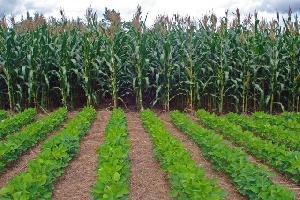
 File photo of a farmland
Young Ghanaians have been urged to look beyond traditional farming and explore opportunities across the agricultural value chain, including food processing, mechanisation, marketing, distribution and technology.
The call was made at the virtual Ghana Agrifood Youth Dialogue organised under the AgraTractive Campaign on Friday, August 28, 2026, on the theme, “Growing Opportunities: How Young People Are Transforming Ghana’s Agrifood System.”
The dialogue brought together young agribusiness entrepreneurs and industry experts to discuss emerging opportunities and the support available to young people seeking to build careers and businesses in Ghana’s agrifood sector.
Principal of the Kumasi Institute of Tropical Agriculture (KITA), Elison Owusu Fordjour, said agriculture should not be viewed solely as farming, stressing that young people can participate at different stages of the value chain.
He said while primary production remains one of the easiest entry points, there are significant opportunities in food processing, value addition, marketing, distribution and agricultural inputs.
“Many young people are venturing into food processing and value addition, which is becoming the talk of the town,” he said.
Fordjour noted that marketing and distribution remained relatively underexplored areas, particularly with the growing use of social media and digital platforms.
He challenged young entrepreneurs to consider how digital marketing could be used to connect consumers to agricultural products and facilitate orders.
He also identified the agricultural input market as another area with potential for innovation, noting that the sector remains largely traditional, with farmers often required to physically visit shops to purchase inputs.
According to him, technology could create more convenient ways for farmers and agribusinesses to access inputs and other services.
Sammi Awuku questions GMA over MV Sankofa waiver and missing US$60,000
Fordjour further encouraged young people without capital to begin with an idea and acquire practical experience by working with established businesses.
“The most important thing is the technical skills,” he said, adding that young people could volunteer or work with existing businesses to gain the experience needed to develop their own enterprises.
He said opportunities under the Young Entrepreneurs for the Future of Food and Agriculture (YEFFA) programme could also help young people develop their ideas, build partnerships and access support.
The 2025 National Youth Best Farmer and agribusiness entrepreneur, Robben Asare, urged young people interested in agriculture not to wait for others to believe in their dreams before taking action.
Asare said his own decision to venture into farming was initially met with resistance from family members and friends, but he remained convinced that agriculture could provide a sustainable livelihood.
“I believe myself. I mean, you dream alone, so you don’t expect anyone to believe in your dream, only yourself,” he said.
He explained that his interest in agriculture was influenced by his upbringing, noting that his father was a farmer and that agriculture supported the upbringing of his six siblings.
“My dad was a farmer and then the six siblings were all raised and grew through the pursuit from agriculture. So with that, I knew farming is the way and it pays, unlike the way people think about it,” he said.
Asare acknowledged that limited resources initially made it difficult for him to enter the sector, but said he eventually took the risk despite concerns about the challenges associated with farming.
He encouraged young people to confront the difficulties in agriculture instead of using them as excuses to stay away from the sector.
“We shouldn’t be giving ourselves excuses. We need to set the example for those that are behind to follow or the generations to come to follow,” he said.
Founder of Mushroom General, Bernice Yawo Agboada, said technological advancements have made agriculture more accessible, particularly for people who do not have large amounts of land or the physical capacity to engage in traditional farming.
She said modern methods of production allow people to undertake agricultural activities with less physical strength, less space and less need for constant physical presence.
“Now thanks to technology, everything has been done in a modernised way that you don’t require a lot of strength, you don’t require a lot of space, you don’t require a lot of you being present fully to make money from agriculture,” she said.
Agboada encouraged young people to take advantage of these opportunities and see agriculture as a business rather than merely a traditional occupation.
Youth, Gender and Enterprise Development Officer at AGRA Ghana, Rubia Abubakar, said the Young Entrepreneurs for the Future of Food and Agriculture (YEFFA) programme was designed to create pathways for young people to participate economically in the agrifood system.
She said the programme works with various organisations to provide skills training, entrepreneurship opportunities, market linkages and other forms of support.
“Our ambition is to reach 1.5 million young people across Africa. Beyond the numbers, what matters is whether that support helps a young person build an enterprise,” she said.
AM
#TrendingGH: 'Revisit the case' - Netizens react to controversial court ruling

Copyright © 1994 - 2026 GhanaWeb. All rights reserved.










