



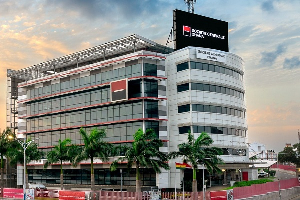
 The proposed sale of SG Ghana's controlling interest has moved well beyond the exploratory stage
Morocco’s Bank of Africa (BOA) and Nigeria’s Access Bank have emerged as the two contenders to buy the 60.22 percent controlling interest in Société Générale Ghana. Burkinabe financial group Coris Bank, founded by Idrissa Nassa, had earlier emerged as a key contender eyeing the acquisition, but has since become reticent about following up.
Similarly the Government of Ghana, having explored a strategic state-backed move to acquire the parent group’s shares in order to maintain a strong indigenous presence – through the Social Security and National Insurance Trust (SSNIT), which already owns a 19 percent minority stake – has also reportedly pulled back.
The proposed sale of Société Générale Ghana’s controlling interest has moved well beyond the exploratory stage, but it has not yet reached the point at which a buyer has been publicly confirmed or a definitive transaction price announced.
The process has reached advanced negotiations and regulatory due diligence by the Bank of Ghana, but is still far from becoming a completed transaction
Bank of Africa, backed by Morocco’s BMCE/Bank of Africa Group, has an obvious strategic advantage in that it already owns BOA Ghana and therefore understands Ghana’s regulatory, economic and banking environment. Its parent has a substantial pan-African footprint, reportedly spanning about 18 African countries.
Its principal attraction would be the possibility of combining two existing Ghanaian operations. BOA Ghana is considerably smaller than SG Ghana, meaning an acquisition could rapidly increase its scale and give the Moroccan group a substantially stronger position in Ghanaian corporate, retail and trade banking.
However, integrating BOA Ghana and SG Ghana would require significant rationalization of branches, personnel, technology platforms and corporate structures. It could also attract closer competition scrutiny because the acquisition would effectively remove one independent bank from the market.
BOA nonetheless has an important advantage: it could potentially present the transaction as a relatively straightforward strengthening of an existing Ghanaian franchise rather than an entirely new entrant.
Access Bank, meanwhile is one of Africa’s most aggressive pan-African banking groups and already operates Access Bank Ghana. Its acquisition of SG Ghana would similarly create a much larger Ghanaian franchise, but with particularly strong potential for integration into the Nigeria-Ghana trade corridor and Access’s wider African network.
The group has pursued an aggressive African expansion strategy and could potentially exploit SG Ghana’s corporate relationships, affluent customer base and established franchise to accelerate its Ghanaian growth.
Its disadvantage is essentially the same as BOA’s: integration of two existing Ghanaian banks.
Instructively how there is no public indication of a definitive preference by Société Générale’s Paris headquartered parent for either BOA or Access Bank.
But the reported bidding contest gives Société Générale an important negotiating advantage as two credible African banking groups appear to want the asset.
The parent is consequently likely to place greatest emphasis on certainty of execution, price, regulatory acceptability and the buyer’s ability to complete the transaction without prolonged negotiations.
Pricing considerations
At the current GSE price of about GH¢5.98 per share, the 709.1 million shares outstanding imply an equity market capitalization of roughly GH¢ 4.24 billion. The French parent’s 427.08 million shares therefore have a quoted market value of about GH¢2.55 billion.
That may not be the likely acquisition price though.
A controlling stake normally attracts a control premium, particularly when two strategic buyers are competing. Investment bankers suggest that the reasonable analytical range would be roughly 15–30 percent above the prevailing market value, implying approximately GH¢2.9–3.3 billion for the 60.22 percent stake, although the actual negotiated price could be outside that range.
This produces an implied whole-bank valuation of roughly GH¢4.9–5.5 billion.
The bank’s underlying fundamentals provide some justification for a premium. Its 2025 capital adequacy ratio was reported at 23.4 percent, comfortably above the regulatory minimum, while 2025 profit after tax was about GH¢397 million. However, SG Ghana’s first-half 2026 profit fell sharply to GH¢128.2 million, down 47.7 percent year-on-year, with Earnings per Share falling from GH¢0.69 to GH¢0.36. A buyer will therefore be reluctant to pay a very aggressive earnings multiple based on 2025 earnings alone.
The transaction’s timing is now principally a question of commercial agreement followed by regulatory and takeover procedures.
A Bank of Ghana-regulated bank acquisition requires BoG approval, with the regulatory decision to be issued within six months of receiving the application.
Consequently, if the parent selects a preferred bidder and the formal application is lodged during the latter part of 2026, completion during late 2026 or the first half of 2027 would be a realistic base case. A dispute over valuation, financing, competition issues or transaction structure could push this further into 2027.
Because acquisition of more than 50 percent of a listed company also engages Ghana’s takeover rules, the eventual transaction could have implications for minority shareholders and potentially trigger a mandatory offer process.
The immediate share-price effect is likely to be positive if the buyer is announced at a premium to GH¢5.98.
Indeed, the stock is already reflecting some takeover driven momentum. Its price is up over 33 percent since the beginning of this year, although it remains well below its 52-week high of GH¢11.51.
“A credible acquisition announcement at, say, GH¢7.00–GH¢7.80 per share would provide an obvious valuation anchor and could push the market price sharply upward” predicts one equity analyst. “Speculative buying could even temporarily take the price beyond the implied acquisition price if investors expect a bidding contest.”
Indeed, the greatest upside would arise if both BOA and Access are prepared to pay aggressively for control. Conversely, if Société Générale settles for a relatively modest premium, the share price could rise initially and then stabilize close to the transaction price.
The longer-term outcome is more complicated. If the acquirer launches a generous mandatory offer for minority shareholders, SG Ghana could eventually become less liquid on the GSE. If the new owner retains the listing and improves earnings through economies of scale, however, the shares could acquire a fresh price appreciation momentum.
For shareholders, the most important near-term catalyst is not SG Ghana’s ordinary earnings but the announcement of the preferred bidder and the price agreed for the French parent’s 60.22 percent stake.
The balance of probabilities favours a higher SG Ghana share price once a firm transaction emerges, with the strongest upside scenario being a competitive BOA-versus-Access process.

Copyright © 1994 - 2026 GhanaWeb. All rights reserved.










