



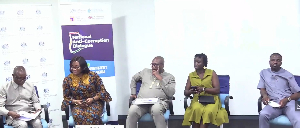
 Some of the stakeholders at the event
Ghana has made progress in the fight against corruption under the administration of President John Dramani Mahama but significant gaps remain and much more must be done to turn political commitments into tangible results, the Ghana Anti-Corruption Coalition (GACC) and other stakeholders revealed.
The assessment was made at a National Anti-Corruption Dialogue organised by the GACC to review the Mahama administration’s anti-corruption agenda since it assumed office in January 2025.
The forum, held under the theme “Reviewing the Mahama Administration Anti-Corruption Agenda,” brought together anti-corruption practitioners, civil society organisations, journalists and other stakeholders to assess government’s performance and identify reforms needed to strengthen Ghana’s anti-corruption architecture.
The dialogue commended several measures undertaken by the government, including the Operation Recover All Loot (ORAL) initiative, the termination of some controversial contracts and the decision to transfer at least 80 percent of the District Assemblies Common Fund directly to metropolitan, municipal and district assemblies.
However, they stressed that such measures must translate into results that ordinary Ghanaians can see and measure. Citizens, they said, must see investigations leading to completed cases, public assets recovered and individuals found culpable facing clear and appropriate consequences.
The Special Prosecutor, Kissi Agyebeng, said his experience at the Office of the Special Prosecutor (OSP) had exposed serious weaknesses in Ghana’s anti-corruption architecture that required urgent attention.
Although government had demonstrated political commitment to the fight against corruption, he said institutional and financial constraints continued to undermine the effectiveness of anti-corruption agencies.
“The government means well,” Agyebeng said, citing collaboration between the OSP and the Commission on Human Rights and Administrative Justice (CHRAJ) in implementing the new National Anti-Corruption Action Plan (NICAP).
“We can boldly say and commend the government that it means well and is striving to do its best in this space,” he stated.
He, however, cautioned that political goodwill alone would not be enough to win the fight against corruption.
Agyebeng called for the OSP to be entrenched in the 1992 Constitution and granted stronger institutional independence.
He argued that without constitutional protection, the OSP could remain vulnerable to political and administrative pressures that could affect its ability to investigate and prosecute corruption cases.
“If we do not write into the Constitution the Office of the Special Prosecutor, however it is called, we are going nowhere,” he warned.
He also called for financial independence for anti-corruption institutions, arguing that agencies expected to investigate powerful individuals and complex corruption cases could not be effective if they remained heavily dependent on government budgetary allocations.
“If you do not grant financial independence and untie these institutions from budgetary restraints, we are going nowhere,” he stated.
Agyebeng said a funding formula had been proposed to provide dedicated financing for anti-corruption institutions and indicated that the proposal was before Parliament.
The Special Prosecutor further advocated non-conviction-based asset recovery, arguing that requiring the state to secure a criminal conviction before pursuing suspicious assets could weaken the fight against corruption.
He said the law should empower the state, subject to due process and judicial oversight, to pursue assets where there was a significant disparity between an individual’s known lawful income and accumulated wealth.
“If we do not stamp that firmly into the pieces of legislation, we are going nowhere,” he said.
Agyebeng also backed appropriate reverse-onus provisions in unexplained wealth cases and called for lifestyle audits.
“Show that you are able to afford these things that you claim you have,” he said, stressing that such measures must respect constitutional rights and due process.
Investigative journalist Manasseh Azure Awuni used the forum to assess President Mahama’s performance against the anti-corruption promises contained in the NDC’s 2024 manifesto.
He referred to Page 52 of the manifesto, which contains a section titled “Restoring Good Governance and Fighting Corruption.”
According to Awuni, the section contains 12 commitments, six of which specifically concern corruption.
He expressed concern about the discontinuation of some cases involving members or affiliates of the governing party, citing the Saglemi housing project and COCOBOD fertiliser scandal.
He argued that where previous charges were considered defective, government could have ordered fresh investigations and pursued new cases where evidence justified such action.
Awuni warned that discontinuing cases involving political allies could establish a dangerous cycle in which successive governments protect their own while pursuing political opponents.
He described the situation as a “very terrible precedent.”
He also questioned whether politically controlled institutions could independently fight corruption.
“Politically controlled state institutions cannot actually fight corruption,” he argued, calling for stronger and more independent anti-corruption institutions capable of investigating cases regardless of the political party in power.
Awuni rejected the perception that civil society organisations were merely “noise-makers,” insisting that their interventions had produced concrete results.
He cited the controversial Agyapa minerals deal, which was referred to former Special Prosecutor Martin Amidu for a value-for-money audit following civil society pressure.
He also mentioned the Aker Energy deal, while highlighting the contribution of the Africa Centre for Energy Policy (ACEP) to his investigation into Strategic Mobilisation Ghana Limited (SML).
According to him, ACEP provided funding, technical guidance and sources that helped support the investigation.
He said the experience demonstrated the importance of cooperation between journalists, civil society organisations and independent institutions in exposing issues of public interest.
The dialogue called for greater scrutiny of sole-sourced public contracts, with participants expressing concern over reports that about 81 Big Push contracts valued at approximately GH¢74 billion had not gone through competitive tendering.
They maintained that competitive procurement should remain the norm and that sole sourcing must be properly justified and subjected to effective oversight.
Participants also identified weak enforcement as a major challenge, arguing that Ghana does not necessarily lack anti-corruption laws but struggles to consistently enforce existing legislation.
AM
“They Were SHOCKED!” Watch Robbery Suspects React as IGP Plays Their Robbery Videos

Copyright © 1994 - 2026 GhanaWeb. All rights reserved.










