



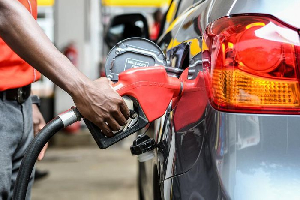
 File photo of a fuel pump
Ghanaian businesses and households alike, as well as government itself, are bracing up for new price shocks in the petroleum products second pricing window for September, due to be announced this week and effective from September 16.
Worries have intensified around the country as the renewed surge in the Brent crude oil benchmark above US$100 per barrel in the second week of September 2026 is likely to create a fresh inflationary test for Ghana.
Brent settled at US$101.21 per barrel on September 9 and subsequently traded above US$105, reaching almost US$110 on September 11 before retreating back to a little over US$100 by the weekend. The immediate trigger is the sharp deterioration in the Middle East security environment and the threat to oil flows through the Strait of Hormuz and other strategic shipping routes.
Brent was still around US$90–92 during the period used to determine Ghana’s first September pricing window. This means the full effect of the current crude oil price surge will emerge in the second pricing window, beginning September 16.
Instructively the expected petroleum price hikes will come just a few days before Ghana‘s biggest commercial road transport union, the GPRTU plans to implement a 30% increase in transport fares – scheduled for September 21 – citing rising fuel and other operating costs.
The first September window already demonstrated the extent to which international petroleum prices were putting pressure on the Ghanaian market. The National Petroleum Authority raised the petrol price floor from GHc13.92 to GHc14.53 per litre and the diesel floor from GHc15.19 to GHc15.60 although at the same time, Government retained a GHc2-per-litre reduction in the regulatory margin on diesel to moderate the impact on consumers.
OMCs initially responded cautiously, barely changing their prices illustrating an important fact that an international oil-price shock does not automatically translate one-for-one into pump prices in Ghana.
OMCs can temporarily absorb part of the increase through margins, inventory positions and competitive pricing. But once inventories purchased at higher international prices have to be replenished, the increased cost must eventually be reflected in pump prices unless another participant in the chain—principally Government—absorbs it.
The second September window is consequently likely to be considerably more difficult for OMCs than the first.
The Chamber of Petroleum Consumers (COPEC) has already warned that the Brent price surge is likely to push Ghanaian pump prices higher from September 16. Its Executive Secretary, Duncan Amoah, has pointed out that crude-price movements take some time to pass through the refining, shipping and importation chain.
A reasonable working scenario being computed by energy economistsis therefore for petrol and diesel prices to rise by roughly 5–10%during the second September window, assuming Brent remains around US$100–110 and the cedi does not suffer a major depreciation. The precise adjustment will depend on the average international refined-product prices, freight and insurance premiums, the exchange rate and the extent to which OMCs absorb part of the increase.
On current pump prices, such an adjustment could put ordinary petrol broadly in the GHc16.20–GHc17.00 per litre range, while diesel could move towards approximately GHc18.00–GHc19.00 if the international shock persists and margins are not compressed.
The impending oil shock is coming at a delicate point in Ghana’s disinflation process.
Consumer inflation fell from 5.3% in June to 4.6% in July—the first decline since March. Producer-price inflation, however, moved in the opposite direction, rising from 3.5% in June to 4.0% in July and instructively, consumer inflation then proceeded to rise again, to 5.0%in August.
Even more instructively, this resulted largely from an acceleration in non-food inflation which rose to 6.8% in August, up from 6.1%–6.7% the previous month, driven largely by transport and utility costs.
Higher petroleum prices therefore threaten to negate any improvements in consumer price inflation (CPI) while accelerating the rise in producer price inflation (PPI).
The announced intention by commercial transport operators to raise fares is potentially even more consequential than the direct increase in fuel prices.
The GPRTU has announced a proposed 30% increase in transport fares from September 21, citing rising fuel and other operating costs.
Even if the eventual approved increase is lower than 30% the implications are substantial because public transport is used extensively by workers, traders, students and businesses.
Government has several options, although none is cost-free.
First, it can temporarily extend or increase the diesel intervention in the form of the existing GH¢2-per-litre reduction in the diesel regulatory margin. But doing so for an extended period would impose a significant fiscal cost, particularly if Brent moves towards US$110–120.
Second, Government could target the intervention rather than subsidize all fuel consumption. Public transport operators, essential food distribution, agriculture and strategically important productive sectors could receive temporary support. This would be cheaper than a universal subsidy.
Third, the authorities could engage OMCs to moderate margins temporarily. Competition has already caused some marketers to hold prices below what the underlying international cost pressures might justify.
However, energy industry and transport sector analysts agree that Government should resist the temptation to respond to the transport-fare threat simply by suppressing fares administratively.
If operators genuinely face a large increase in fuel and maintenance costs, an imposed fare freeze merely transfers the financial problem to drivers and owners and risks service deterioration. A temporary, transparent transport-support mechanism would be more sustainable.
For Ghana, a temporary Brent price of US$100 is uncomfortable but manageable. The more serious threat would be Brent remaining above US$100 for several months.

Copyright © 1994 - 2026 GhanaWeb. All rights reserved.










