



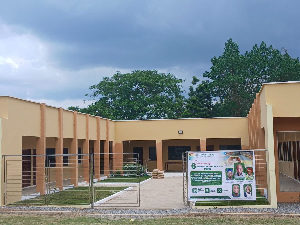
 The Education Ministry will adopt Asuogyaman’s school model from 2027.
The Ministry of Education will adopt the newly completed school infrastructure model in the Asuogyaman District of the Eastern Region as a template for basic education infrastructure development across Ghana from 2027.
Education Minister Haruna Iddrisu said the model would form part of the government's strategy to address the country's basic school infrastructure deficit and provide pupils with standard learning facilities irrespective of their location.
Speaking at the commissioning of newly constructed school facilities at Asikuma, Tortibo, Senchi, Asempaneye, Aboasa and Adome in the Asuogyaman constituency on Monday, September 14, 2026, Iddrisu said the government was preparing to scale up investment in basic education infrastructure.
He said the proposed model would go beyond the provision of classrooms to create a comprehensive learning environment for children.
According to him, a model basic school would comprise a 12-unit classroom block covering kindergarten, primary and junior high school, as well as a dining hall and kitchen, STEM and computer laboratory, toilet facilities and a changing room for girls.
"We will be adopting this model basic school as the basic education model for the whole of Ghana," the minister said.
He disclosed that the government was seeking additional World Bank financing to support investment in basic education infrastructure from 2027.
The Education Minister noted that the government's objective was to ensure that children in deprived communities were provided with learning environments comparable to those available to pupils in more developed parts of the world.
"For us, a learner in an Asuogyaman classroom is as good as a learner in a classroom in Sweden or America if he is given the same environment and standard of study," he said.
Robotics, AI and coding for basic schools
The Education Minister also announced plans to introduce emerging technology skills at the basic education level as part of the revised curriculum.
He said pupils would be exposed to areas including robotics, electronics, artificial intelligence and coding to equip them with foundational digital skills.
Iddrisu said the revised curriculum for kindergarten through primary school was being finalised and would subsequently go through the required government processes.
According to him, the intervention was intended to prepare Ghanaian children for a technology-driven future from an early age.
Government to expand SHS infrastructure
The minister further said the government had identified infrastructure, teacher availability and quality assurance as key areas requiring attention in its review of the Free Senior High School programme.
He said the government was planning infrastructure expansion in 150 senior high schools across the country.
He also announced plans for the construction of 10 Category A model senior high schools in different parts of Ghana.
According to him, eight senior high schools in the Eastern Region would benefit from planned interventions supported by the World Bank.
The Minister furthered that the government's approach was to match the expansion in access to senior high school education with the necessary classrooms, dormitories, laboratories and other facilities.
Basic education infrastructure deficit
Haruna Iddrisu said the government's intervention was necessary because of the continuing infrastructure challenges facing basic education in parts of the country.
He commended the Asuogyaman Member of Parliament and Deputy Minister for Finance, Thomas Nyarko Ampem, and District Chief Executive, Godwin Bobobee for prioritising education infrastructure in the area.
He described the completed facilities as an example of the type of infrastructure the government wanted to see replicated across the country.

Copyright © 1994 - 2026 GhanaWeb. All rights reserved.










