



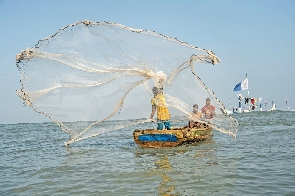
 Marine fish production stood at 442,361 metric tonnes in 2024
Ghana’s drive to reduce its dependence on imported fish faces fresh pressure after the fishing sub sector contracted by 24.7 percent in the second quarter of 2026, threatening efforts to close a domestic fish supply deficit valued at between US$600 million and US$800 million annually.
The country requires between 1.2 million and 1.28 million metric tonnes of fish annually, against domestic production estimated at between 550,000 and 684,000 metric tonnes, leaving a supply gap of roughly 590,000 to 700,000 metric tonnes.
The latest contraction raises the risk that Ghana could struggle to maintain gains made in reducing fish imports unless capture fishing recovers and aquaculture expands sufficiently to compensate for the domestic shortfall.
Latest Ghana Statistical Service data show the fishing subsector contracted by 24.7 percent in the second quarter of 2026, representing a 25.6 percentage-point deterioration from its performance in the corresponding period of 2025.
Fishing was the only agricultural subsector to contract during the quarter. Agriculture as a whole expanded by 3.9 percent, with crops growing by 5.2 percent, livestock by 5.9 percent and forestry and logging by 10.7 percent.
The contraction threatens gains made in reducing fish imports, which fell from 273,382 metric tonnes in 2021 to 79,550 metric tonnes in 2024, representing a decline of about 71 percent within three years.
Despite the reduction, imported fish remained an important part of domestic supply in 2025. Fisheries and Aquaculture Minister Emelia Arthur said in October last year that Ghana was still importing more than 79,000 metric tonnes of fish annually to meet domestic demand as declining marine stocks continued to constrain local production.
The continued dependence was also evident during government’s engagement with the Bulk Fish Importers Association in April 2025, when the association said its members supplied between 60 and 80 percent of fish consumed in the country.
The importers raised concerns over operating costs and the Fisheries Development Levy, highlighting the continuing role of imported frozen fish in supplying the domestic market despite efforts to increase local production.
The pressure on domestic supply is particularly significant because government has identified increased aquaculture production as one of the main routes for reducing fish imports.
Marine fish production stood at 442,361 metric tonnes in 2024, while inland fisheries produced 131,552 metric tonnes. Aquaculture contributed another 121,809 metric tonnes, up from 116,108 metric tonnes in 2023 but below the 145,500-tonne target for the year.
For 2025, government targeted aquaculture production of about 160,414 metric tonnes, requiring an increase of more than 38,000 tonnes over the previous year’s output. The expansion was intended to increase the contribution of farmed fish as pressure on marine and inland fisheries persisted.
Aquaculture production in 2026 is projected at about 132,710 metric tonnes, which remains insufficient on its own to close a national supply deficit running into hundreds of thousands of tonnes.
Government is consequently pursuing a broader expansion of commercial aquaculture.
Under the Ghana National Aquaculture Development Plan for 2024-2028, commercial farmed-fish production is targeted to increase from 116,107.83 metric tonnes in 2023 to 238,655.49 metric tonnes by the end of 2028.
Achieving the target requires average annual production growth of about 15.5 percent. The plan also seeks to increase the market share of commercially farmed fish from 14 percent in 2021 to 25 percent by 2028 and raise the value of farmed fish from US$132.86million to US$314.70million.
The programme is estimated to require about GH¢1.03 billion in investment, with GH¢348.06 million expected from government and about GH¢681.23 million from domestic and foreign private investors.
Government is also pursuing a US$20 million investment plan for Aquaculture Economic Zones to expand farmed-fish production and attract additional private capital into the industry.
The Fisheries Ministry is further developing commercial offshore aquaculture as another source of domestic fish supply. Ghana has issued its first provisional license for commercial offshore marine aquaculture, while a Marine Aquaculture Policy is being developed to provide the regulatory framework for investment in the emerging industry.
The expansion of aquaculture has become increasingly important because prospects for significantly increasing capture fishing remain constrained.
The Fisheries Ministry has identified overfishing, illegal, unreported and unregulated fishing, climate change, habitat degradation, high operating costs, inadequate infrastructure and enforcement weaknesses among the factors affecting domestic fish stocks.
Some key marine stocks have fallen sharply. Sardinella stocks, an important component of Ghana’s artisanal fisheries, have been estimated at about 13.8 percent of sustainable levels, increasing pressure on government to rebuild marine resources while developing alternative sources of fish supply.
Government has maintained closed fishing seasons as part of the recovery programme. Industrial trawlers observed a two-month closure from July 1 to August 31 this year, while semi-industrial vessels were closed during July. Artisanal canoe fishers were exempted from the 2026 closed season.
The contraction in the second quarter preceded those closures, indicating that the 24.7 percent decline cannot be attributed to the 2026 closed season.
Government has also increased the supply of subsidized premix fuel to fishing communities. About 22.41 million litres were supplied between January and June 2026, more than 58 percent above the corresponding period of 2025 and over 20 percent higher than the first half of 2024.
The increased fuel supply has not prevented the contraction in fishing activity, pointing to wider production constraints facing the industry beyond the availability of premix fuel.
Those constraints leave aquaculture carrying a growing share of government’s strategy to increase domestic fish supply. Fish farmers continue to contend with high feed costs, access to quality fingerlings, disease risks, financing constraints and inadequate cold-chain infrastructure, all of which affect the pace at which production can be expanded.
With Ghana still facing a fish supply deficit of at least 590,000 metric tonnes annually, the 24.7 percent contraction increases the amount of production that must be recovered from capture fisheries or generated through aquaculture if the country is to continue reducing its dependence on imports.
Failure to close the gap through domestic production could reverse part of the 71 percent reduction in fish-import volumes recorded between 2021 and 2024, leaving imported fish to play a larger role in meeting Ghana’s annual consumption requirement.

Copyright © 1994 - 2026 GhanaWeb. All rights reserved.










