



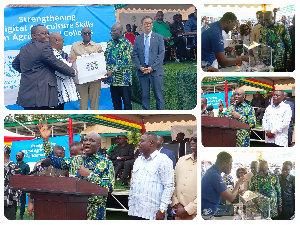
 Collage of Hon Eric Opoku, COICA representative and other stakeholders during ceremony in Kumasi
The Ministry of Food and Agriculture (MoFA), in collaboration with the World Food Programme (WFP) and with support from the Korea International Cooperation Agency (KOICA), has provided agricultural technology equipment and digital tools to five agricultural colleges.
The beneficiary institutions are the Ejura, Ohawu, Kwadaso, Wenchi and Damongo Agricultural Colleges. The equipment was handed over at a ceremony held at Kwadaso Agricultural College under the theme: “Transforming Agricultural Education Through Digitalization, Innovation and Smart Technology.”
Presenting the equipment, the Minister for Food and Agriculture, Hon. Eric Opoku, said the initiative aims to strengthen agricultural education and prepare students for modern, data-driven farming.
The items include 60 moisture meters, 60 soil testers, 15 mini drones, 60 greenhouse environmental-control learning kits, 60 Internet of Things (IoT) sensor kits, GPS devices, weather-station kits, high-performance computers and agricultural simulation software.
The intervention is expected to connect classroom learning with practical training and help position the colleges as centres for innovation, research and entrepreneurship.
WFP Country Director Aurore Rusiga said digital technology could help address challenges such as food insecurity, climate variability, declining soil health and post-harvest losses. However, she stressed that technology must be accompanied by people with the skills to apply it effectively.
“Technology alone is not enough. Realising its potential requires people with the knowledge and skills to apply it effectively in real agricultural settings,” she said.
Ms. Rusiga noted that agricultural colleges train extension officers and technicians who support small holder farmers. Incorporating digital skills into their curricula, she added, could improve the quality and reach of agricultural extension services.
The Country Director of KOICA’s Ghana Office, Mr. Dong Wan Woo, reaffirmed the agency’s commitment to developing human capacity and supporting technological innovation in Ghana’s agricultural sector.
He said young agricultural professionals needed practical experience with modern tools, in addition to classroom knowledge, to respond effectively to changes in the sector.
“Agriculture is changing rapidly, and technology is becoming more important in how farmers access information, manage risks and make decisions. Young agricultural professionals therefore need not only classroom knowledge, but also practical experience with modern technologies,” Woo said.

Copyright © 1994 - 2026 GhanaWeb. All rights reserved.










