



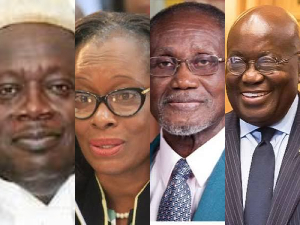
 The office itself remains constitutionally central to Ghana's justice system
The Office of the Attorney General is one of the most important positions in Ghana's constitutional and legal architecture.
Under Article 88 of the 1992 Constitution, the Attorney General is the principal legal adviser to the government, is responsible for initiating and conducting criminal prosecutions, and handles civil cases on behalf of the State.
Since the beginning of the Fourth Republic in 1993, the office has changed hands several times, with some Attorney General serving for years while others had relatively short tenures.
Here is a look at the 13 individuals who have served as Attorney General since 1993, their periods in office and some of the notable aspects of their careers.
1. Anthony Forson
Anthony Forson became Attorney General and Minister of Justice on March 1, 1993, at the beginning of Ghana's Fourth Republic under President Jerry John Rawlings.
His tenure was brief. He resigned on October 30, 1993, after about eight months in office, and was succeeded by Obed Yao Asamoah. Forson, a lawyer who was called to the Ghana Bar in 1964, later served as Ghana's High Commissioner to India from 1994 to 1997.
His brief tenure makes him the shortest-serving Attorney General on the list.
2. Obed Yao Asamoah — 1993–2001
Obed Yao Asamoah took over following Forson's resignation. He initially served as Acting Attorney General from November 1993 to May 1997, before becoming the substantive Attorney General.
He remained in the position until January 6, 2001, making him one of the longest-serving occupants of the office in Ghana's Fourth Republic.
Election Petition: GBA intervenes on behalf of three NDC lawyers hauled before GLC disciplinary committee
He served under President Rawlings and was also Foreign Affairs Minister for many years during the Rawlings administration.
His tenure therefore covered the early years of the Fourth Republic and most of Rawlings' two elected presidential terms.
3. Former President Nana Addo Dankwa Akufo-Addo — 2001–2003
Former President Nana Addo Dankwa Akufo-Addo became Attorney General and Minister of Justice after the New Patriotic Party won the 2000 presidential election and John Agyekum Kufuor assumed office.
He served from February 2001 to April 2003 before being moved to the Foreign Affairs Ministry.
One of the major legal reforms associated with his tenure was the repeal of the criminal libel law, while he also pursued reforms aimed at improving Ghana's justice system, including the automation of the courts.
Akufo-Addo later became President of Ghana, serving from 2017 to 2025.
Papa Owusu-Ankomah succeeded Akufo-Addo as Attorney General and Minister of Justice in April 2003.
A lawyer and former Member of Parliament for Sekondi, he had already served in parliamentary leadership before taking charge of the Justice Ministry. He remained Attorney General until 2005, when he was succeeded by J Ayikoi Otoo.
During his tenure, the Attorney General's Department continued its constitutional responsibilities involving criminal prosecutions, civil litigation and legal advice to government.
5. J Ayikoi Otoo — 2005–2006
J Ayikoi Otoo became Attorney General and Minister of Justice in February 2005, succeeding Papa Owusu-Ankomah.
Attorney-General defends decision to discontinue Ato Forson’s trial
A lawyer and New Patriotic Party politician, Otoo had a long career in legal practice and later served as Ghana's High Commissioner to Canada.
His tenure at the Justice Ministry lasted roughly a year before he was succeeded by Joe Ghartey in 2006.
6. Joe Ghartey — 2006–2009
Joe Ghartey became Attorney General and Minister of Justice on June 16, 2006, after previously serving as Deputy Attorney General and Deputy Minister for Justice.
He remained in office until January 2009, following the NPP's defeat in the 2008 general election. He was the longest-serving Attorney General under the Kufuor administration.
One of the initiatives associated with his tenure was the Justice for All Programme, which sought to address the problem of prisoners who had spent prolonged periods on remand without trial.
Ghartey later said the programme was designed to improve access to justice and provide relief to people held in custody for long periods.
He later served as Second Deputy Speaker of Parliament and Minister of Railway Development.
7. Betty Mould-Iddrisu — 2009–2011
Betty Mould-Iddrisu made history in February 2009 when she became Ghana's first female Attorney-General and Minister for Justice under President John Evans Atta Mills.
Before entering government, she had extensive experience in international law and human-rights advocacy and had also lectured at the University of Ghana's Faculty of Law.
She served as Attorney General until 2011, when she was moved to the Ministry of Education. She subsequently left the Education Ministry in 2012.
8. Martin Amidu — 2011–2012
Martin Alamisi Burns Kaiser Amidu succeeded Betty Mould-Iddrisu as Attorney-General and Minister for Justice.
He took over on January 21, 2011, and remained in the position until January 19, 2012.
FULL TEXT: Why Attorney General discontinued high-profile cases against government appointees
His tenure was relatively short, lasting about a year. Amidu later returned to Ghana's anti-corruption landscape as the country's first Special Prosecutor, taking office in 2018.
9. Benjamin Kunbuor — 2012–2013
Benjamin Kunbuor became Attorney General and Minister of Justice in January 2012, succeeding Martin Amidu.
He served during a politically significant period that included the transition following the death of President Mills and the assumption of office by Vice-President John Dramani Mahama.
As Attorney General, Kunbuor represented the State in important cases before the Supreme Court.
One notable case during his tenure was Attorney General v Balkan Energy Ghana Ltd, in which the Supreme Court considered the constitutional meaning of an international business or economic transaction involving the government. The case was decided in May 2012.
Kunbuor's tenure ended in early 2013, when Marietta Brew Appiah-Oppong took over.
10. Marietta Brew Appiah-Oppong — 2013–2017
Marietta Brew Appiah-Oppong became Attorney General and Minister of Justice in February 2013 under President John Dramani Mahama.
She was the second woman to occupy the office, following Betty Mould-Iddrisu.
Her tenure included Ghana's high-profile maritime boundary dispute with Côte d'Ivoire before the International Tribunal for the Law of the Sea (ITLOS).
Appiah-Oppong served as Ghana's Agent in the case and represented the country through a major part of the proceedings.
In February 2017, as she handed over to her successor, Gloria Akuffo, she noted before the tribunal that she had served as Ghana's Agent since the case began in 2014.
The ITLOS case eventually resulted in a ruling in Ghana's favour in September 2017.
11. Gloria Afua Akuffo — 2017–2021
Gloria Afua Akuffo became Attorney General and Minister of Justice in January 2017, following the election of Nana Akufo-Addo as President.
A lawyer with extensive experience in private practice, she had previously served as Deputy Attorney-General and Minister for Aviation under the Kufuor administration.
One of the major matters she inherited was the Ghana-Côte d'Ivoire maritime boundary case at ITLOS.
She formally took over as Ghana's Agent in the case from Appiah-Oppong in February 2017 and presented Ghana's submissions during the final stage of the proceedings.
Her tenure ended in January 2021, when she was succeeded by Godfred Yeboah Dame.
12. Godfred Yeboah Dame — 2021–2025
Godfred Yeboah Dame became Attorney General and Minister of Justice in 2021, after previously serving as Deputy Attorney-General and Deputy Minister for Justice from 2017.
He was nominated by President Akufo-Addo on January 21, 2021, and was sworn into office on March 5, 2021, following parliamentary approval.
Before becoming Attorney General, Dame was involved in several high-profile cases on behalf of the government, including litigation involving Alfred Agbesi Woyome, the Exton Cubic mining leases, the creation of new regions and the compilation of a new voters' register.
As Attorney General, he also represented Ghana at international forums, including the United Nations' Universal Periodic Review on human rights.
In 2023, he presented Ghana's national human-rights report in Geneva and discussed issues including access to justice, anti-corruption measures and legal reforms.
Dame left office in January 2025 following the change of government.
13. Dominic Akuritinga Ayine — 2025–present
Dr Dominic Akuritinga Ayine became Attorney General and Minister of Justice in January 2025 under President John Dramani Mahama.
The Presidency announced his nomination in January 2025, and he subsequently took office following parliamentary approval and swearing-in.
Ayine is a legal scholar, lawyer and politician who represents the Bolgatanga East Constituency in Parliament. He previously served as Deputy Attorney General and Deputy Minister for Justice under Mahama from 2013 to 2017.
He holds advanced degrees in international economic and trade law, including an LLM from the University of Michigan and a second LLM and JSD from Stanford Law School. He also previously taught law and worked in public-interest legal advocacy.
As of October 2026, Ayine remains the Attorney General and Minister of Justice, making him the latest occupant of the office in the Fourth Republic.
The history of the Attorney General's office since 1993 reflects Ghana's political transitions under the Fourth Republic.
The position has been held by lawyers who later became presidents, diplomats, legislators, ministers and senior figures in Ghana's legal system.
It has also seen important milestones in gender representation, with Betty Mould-Iddrisu becoming the first woman to occupy the office in 2009, followed by Marietta Brew Appiah-Oppong and Gloria Akuffo.
The office itself remains constitutionally central to Ghana's justice system, with the Attorney General serving as the government's principal legal adviser and having responsibility for both criminal prosecutions and civil proceedings involving the State.
MRA/VPO
NDC won’t intimidate us; we will fight until victory in 2028 – Afenyo Markin

Copyright © 1994 - 2026 GhanaWeb. All rights reserved.










