



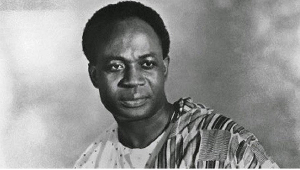
 Dr Kwame Nkrumah, Ghana’s first President
Kwame Nkrumah, Ghana’s first President and one of the most influential figures in Africa’s independence movement, has been profiled by the London School of Economics and Political Science (LSE), where he once studied as a PhD candidate.
The LSE profile examines Nkrumah’s political journey, his role in Ghana’s independence, and his contribution to Pan-Africanism and the development of the concept of neo-colonialism.
It highlights Nkrumah’s journey from a former PhD candidate at LSE to becoming Ghana’s first President and one of the leading figures in post-colonial Africa.
LSE described Nkrumah as a driving force behind the practical and ideological underpinnings of Pan-Africanism and the understanding of neo-colonialism.
Nkrumah was born in what is now Ghana but was then known as the Gold Coast in 1909.
He subsequently emigrated to pursue his education and, in May 1945, enrolled as a PhD candidate in anthropology at LSE before transferring to University College to study philosophy under AJ Ayer.
While in the UK, he attended the highly influential 5th Pan-African Congress in Manchester, which featured three future heads of state: Hastings Banda of Malawi, Jomo Kenyatta of Kenya and Nkrumah.
He returned to the Gold Coast in 1947 and joined the United Gold Coast Convention (UGCC), which sought self-government at the earliest opportunity.
Following internal divisions with other leading members of the UGCC, he formed the Convention People’s Party (CPP) in 1949.
He was imprisoned in 1950 after supporting a general strike that turned violent. In the 1951 general election, Nkrumah’s party won 34 out of the 38 seats despite him being in prison throughout the campaign.
He became Prime Minister of the Gold Coast when the position was created in 1952 and became independent Ghana’s first Prime Minister in 1957.
In 1960, Ghana became a republic and Nkrumah became the country’s first President. In 1964, a constitutional amendment made him president for life, but he was deposed in a military coup in 1966 while on a diplomatic visit to North Vietnam.
For the remaining years of his life, Nkrumah settled in Guinea-Conakry. He died in Bucharest, Romania, in 1972 while undergoing treatment for prostate cancer.
The profile further indicated that, in addition to being the first democratic leader of a post-colonial African nation, Nkrumah had a substantial legacy as a political theorist.
How Dr Busia's death was announced in 1978
He is credited with being the first to apply the term ‘neo-colonialism’ to the experience of Africa in the 20th century, although Jean-Paul Sartre is believed to have coined the term in the 1950s.
The profile described Nkrumah as a Marxist. He believed that despite African countries being granted formal independence, financial structures continued to prevent the development of the continent for the benefit of Africans while enriching people and institutions in former colonial powers.
Upon independence, African states, faced with a power vacuum and a desire to fund programmes to develop their countries, welcomed aid, finance and international corporations.
This created a new scramble for Africa, Nkrumah argued, but this time at the behest of local elites.
JKB/VPO
How a Visit to GHACEM Inspired Ibrahim Mahama to Build Dzata Cement

Copyright © 1994 - 2026 GhanaWeb. All rights reserved.










