



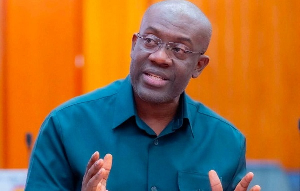
 Kojo Oppong Nkrumah is the Member of Parliament for Ofoase Ayirebi
The Member of Parliament for Ofoase-Ayirebi Constituency and Ranking Member of Parliament’s Economy and Development Committee, Kojo Oppong Nkrumah, has challenged the government to account for its unfulfilled economic promises before introducing what it describes as a “New Economy”.
He has also challenged the government to provide evidence, including SSNIT records, to prove that jobs have been created under the 24-Hour Economy.
Oppong Nkrumah, in a statement, said while he supported the government’s objective of increasing domestic production and creating jobs, Ghanaians deserved a comprehensive assessment of programmes introduced by the National Democratic Congress (NDC) since it assumed office.
According to him, the government had spent recent weeks promoting the “New Economy”, with the Finance Minister, Dr Cassiel Ato Forson, engaging the Association of Ghana Industries, the Trade Ministry and the banking sector ahead of the full announcement of the initiative in the 2027 Budget.
He, however, questioned whether the proposed initiative represented a genuinely new economic direction or a rebranding of programmes already contained in existing government policies.
“The difficulty is that this administration came to office with a string of programmes it said would deliver exactly this and almost none of them can show results,” Oppong Nkrumah said.
He cited the government’s 24-Hour Economy, Women’s Development Bank, One Million Coders Programme and Feed Ghana initiative, particularly the Nkoko Nkitinkiti poultry component, as programmes requiring greater public accountability.
24-Hour Economy
On the 24-Hour Economy, Oppong Nkrumah said the programme was presented as the centrepiece of the NDC’s economic plan, with a promise to create 1.7 million decent jobs by the end of 2028.
He questioned claims about jobs created under the programme, arguing that announcements of employment without verifiable evidence made it difficult for Ghanaians to assess its impact.
He said the government had cited 268 filling stations and 33 manufacturers operating in shifts as part of the programme’s achievements, while also referring to 160,000 jobs expected from recently signed agreements.
“Until we can see the workers, the firms employing them and the SSNIT contributions being paid on their behalf, Ghanaians have no way of knowing whether those jobs exist,” he said.
Women’s Development Bank
Oppong Nkrumah also raised concerns about the pace of implementation of the Women’s Development Bank, which he described as one of the attractive promises made during the 2024 election campaign.
He said the bank, despite receiving significant budgetary allocations, had yet to provide loans to women.
According to him, the government allocated GH¢51.3 million to the institution in 2025 and several hundred million cedis more in 2026, while the Finance Minister had told Parliament that GH¢400 million had been deposited at the Bank of Ghana as capital.
He noted that the company was incorporated only in January 2026 and was still awaiting a banking licence.
“Market women who were told help was coming are still borrowing from susu collectors and moneylenders at the same punishing rates,” he said.
The MP similarly questioned the government’s reported progress under the One Million Coders Programme, arguing that the number of people who had completed at least one module did not necessarily translate into trained coders or jobs.
Questions Feed Ghana programme
Turning to agriculture, Oppong Nkrumah criticised the implementation of Feed Ghana and its poultry component, Nkoko Nkitinkiti.
He said the programme was intended to reduce Ghana’s dependence on imported chicken by encouraging households to engage in poultry production.
However, he cited comments attributed to the Agriculture Minister that some beneficiaries had consumed the birds rather than rearing them, as well as criticism from the Poultry Farmers Association describing the first phase as an “abysmal failure”.
He called for the publication of data showing how many beneficiaries remained in production and the programme’s impact on poultry imports.
Oppong Nkrumah also questioned the proposed scale of the New Economy, which he said would commit about US$10 billion over four years to commercial agriculture, mining value addition, energy and transport infrastructure.
He argued that several of the sectors identified under the new initiative were already covered by existing government programmes.
“Commercial agriculture already sits under Feed Ghana. Agro-processing and energy projects such as the Buipe solar plant are already listed under the 24-Hour Economy. Access to finance for small producers was the whole point of the Women’s Development Bank,” he said.
The former Information Minister also rejected the government’s suggestion that its policies were responsible for Ghana’s recent macroeconomic improvements.
He argued that the economic stabilisation measures currently benefiting the country were largely rooted in policies implemented under the previous New Patriotic Party (NPP) administration.
Oppong Nkrumah pointed to the IMF programme secured in May 2023, the domestic debt exchange, the June 2024 agreement with bilateral and commercial creditors and the Eurobond exchange.
He said inflation had declined from 54.1 per cent at the end of 2022 to 23.8 per cent by the time of the 2024 election, while the economy recorded 5.7 per cent growth in 2024.
“The NDC inherited that programme, ran it to its final review in July 2026, and has taken the harvest to market with its own label on it,” he said.
He further questioned the government’s decision to reduce the primary surplus requirement from 1.5 per cent of GDP to 0.5 per cent from 2027 to create fiscal space for the New Economy.
With about GH¢58 billion in restructured domestic bonds falling due in 2027 and another GH¢53 billion in 2028, he said Parliament and the public had a right to demand clarity on how the government intended to manage the obligations.
Call for parliamentary scrutiny
Oppong Nkrumah urged the government to suspend the rollout of the New Economy until it had properly accounted for the programmes it introduced earlier.
He called for a verifiable register of jobs created under the 24-Hour Economy, including checks against payroll and SSNIT records.
He also demanded a firm date for the Women’s Development Bank to commence lending, publication of its lending criteria, data on One Million Coders graduates who had secured employment and an independent audit of beneficiaries under Nkoko Nkitinkiti.
He further called on the Finance Minister to present Parliament with a costed plan for the 2027 and 2028 debt maturities and evidence of progress on reforms identified by the IMF.
“Parliament should not agree to weaken the country’s fiscal anchor to fund a programme whose details have not even been published,” Oppong Nkrumah said.
He maintained that the promises made to Ghanaians during the 2024 election remained binding on the government, insisting that the administration must account for those commitments before asking the public to embrace another economic programme.

Copyright © 1994 - 2026 GhanaWeb. All rights reserved.










