



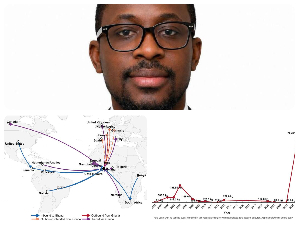
 Collage of Dr Owusu Fodjour and records of cocaine transport and seizure
Academic researcher and environmental expert Dr Owusu Fordjour Aidoo has raised concerns over a sharp increase in documented cocaine seizures linked to Ghana, saying the trend could point to changing trafficking methods and growing pressure on the country’s security systems.
An analysis of publicly documented cases from 2001 to September 2026 recorded approximately 16.5 tonnes of cocaine linked to Ghana. Of this, about 12.2 tonnes, representing 74 per cent of the total, was seized in 2025 and 2026 alone, including major interceptions in Ghana and Europe.
According to the analysis, approximately 53 per cent of the recorded cocaine was intercepted after leaving Ghana, while 21 per cent was seized within the country and 18 per cent was intercepted while entering Ghana.
Among the largest cases were a seizure of approximately 3.3 tonnes at Pedu Junction in Cape Coast in 2025 and an interception of nearly 3.9 tonnes at France’s Port of Dunkirk in September 2026. The latter consignment was found in a shipping container reportedly arriving from Ghana.
In an article copied to GhanaWeb, Dr Aidoo said the recent cases highlighted a possible shift from smaller quantities transported by individual couriers to larger consignments moved through commercial cargo and shipping containers.
He said the trend could require stronger container screening, improved port security and greater intelligence-sharing between Ghana and its international partners.
However, the analysis covers only verified seizures reported publicly and should not be treated as an estimate of the total volume of cocaine trafficked through Ghana. Undetected or unreported cases are excluded, meaning the actual scale could be higher.
Read his full article below:
Ghana’s shifting role in trafficking routes
A new analysis of documented cocaine seizures linked to Ghana over the past 25 years has found that nearly three-quarters of the total volume recorded in the dataset was seized within the last two years.
The findings, drawn from verified cases spanning 2001 to September 2026, identified approximately 16.5 tonnes of cocaine linked to Ghana across documented incidents. Of this total, about 12.2 tonnes, representing 74 per cent, was recorded in 2025 and 2026 alone.
The sharp increase was driven by several exceptionally large seizures recorded both in Ghana and in European destination markets. The pattern could reflect an actual increase in trafficking volumes, improved detection and interdiction capacity, or a combination of both.
The data suggest that Ghana occupies multiple positions along international cocaine trafficking routes rather than serving as a single point of origin, transit or destination.
About 53 per cent of the recorded volume involved cocaine intercepted after leaving Ghana, underscoring the country’s continued use as a transit and onward-shipment point for traffickers targeting Europe and other international markets.
A further 21 per cent involved seizures made within Ghana, while the remaining 18 per cent involved cocaine intercepted while entering the country.
Record seizures and changing trafficking methods
Two seizures stand out as the largest confirmed cases in the dataset, illustrating the scale of some recent trafficking operations.
The largest domestic seizure occurred in 2025, when Ghanaian authorities intercepted 3,319.66 kilogrammes, or approximately 3.3 tonnes, of cocaine at Pedu Junction in Cape Coast in the Central Region.
In September 2026, French authorities intercepted nearly 3,900 kilogrammes, or approximately 3.9 tonnes, of cocaine at the Port of Dunkirk. The consignment was found in a shipping container reportedly arriving from Ghana.
Together, the two seizures accounted for more than half of the 12.2 tonnes recorded in 2025 and 2026, illustrating how a small number of large interceptions can significantly influence overall figures.
Beyond the total volume, the analysis points to a possible evolution in trafficking methods over the period under review.
Earlier records were dominated by cocaine carried by individual air passengers, concealed in personal luggage or transported through air freight. By contrast, some of the largest and most recent cases involved commercial cargo, shipping containers and large road consignments.
The pattern suggests the possible involvement of more organised and better-resourced trafficking networks capable of exploiting legitimate trade and logistics routes to conceal large quantities of narcotics.
If sustained, the shift could have implications for port security, container scanning and supply-chain due diligence at Ghana’s entry and exit points.
Data limitations and implications for Ghana
The analysis cautions against interpreting the figures as an estimate of the total volume of cocaine trafficked through Ghana over the 25-year period. The 16.5-tonne figure represents only documented seizures identified through publicly available records.
Cocaine that escaped detection, as well as cases that were not publicly reported or could not be independently verified, was excluded. The actual scale of trafficking linked to Ghana could therefore be considerably higher than the recorded figures suggest.
The concentration of nearly three-quarters of the recorded cocaine seizures within a two-year period could intensify scrutiny of Ghana’s ports, free zones and road transport corridors.
As trafficking methods potentially shift towards commercial cargo and shipping containers, Customs and port authorities may face greater pressure to screen large volumes of legitimate trade without disrupting commerce.
The trend also has potential public health implications. Even when Ghana serves primarily as a transit point rather than a destination market, trafficking networks operating within the country may create risks, including the diversion of drugs into local markets and corruption within logistics and law enforcement systems.
The findings could add to discussions among Ghanaian security agencies, regional trafficking-monitoring bodies and European counterparts on strengthening detection capacity, container-scanning infrastructure and cross-border intelligence-sharing.
Key findings at a glance
16.5 tonnes: Total documented cocaine seizures linked to Ghana between 2001 and September 2026.
12.2 tonnes: Recorded in 2025 and 2026, representing 74 per cent of the total.
53 per cent: Cocaine intercepted after leaving Ghana.
21 per cent: Seizures made within Ghana.
18 per cent: Cocaine intercepted while entering Ghana.
3.32 tonnes: Seized at Pedu Junction in Cape Coast in 2025.
Approximately 3.9 tonnes: Intercepted at France’s Port of Dunkirk in September 2026 in a shipment reportedly arriving from Ghana.

Copyright © 1994 - 2026 GhanaWeb. All rights reserved.










