



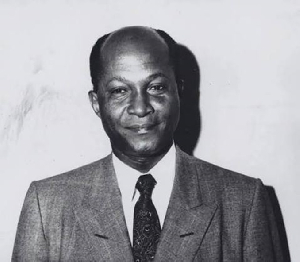
 Komla Agbeli Gbedemah
Ghana’s Former Finance Minister, Komla Agbeli Gbedemah, confronted racial discrimination in the United States in 1957, prompting then-President Dwight D. Eisenhower to apologise after a restaurant in Delaware refused to allow him to dine inside because he was Black.
The incident occurred on October 10, 1957, just seven months after Ghana gained independence from British colonial rule. Gbedemah was in the United States on official business when he and his American secretary, William Sutherland, stopped at a Howard Johnson restaurant in Dover, Delaware, for refreshments.
Although the two men were given orange juice, they were told they could not consume it inside the restaurant because of their race. The drinks were packaged for takeaway, prompting Gbedemah to protest the treatment.
According to a contemporary account published by TIME magazine, Gbedemah questioned why he should face such treatment in the United States, especially after hosting American Vice-President Richard Nixon at his home in Ghana earlier that year.
“If the Vice President of the U.S. can have a meal in my house when he is in Ghana, then I cannot understand why I must receive this treatment at a roadside restaurant in America,” he said.
Gbedemah reportedly paid for the drinks but left them untouched before walking out of the restaurant.
The incident quickly attracted international attention, putting the United States under pressure over its treatment of Black people, including visiting African diplomats. The US State Department moved to address the matter, with officials describing it as an isolated incident and expressing regret over the treatment meted out to the Ghanaian minister.
President Eisenhower subsequently invited Gbedemah to breakfast at the White House on October 10, 1957, alongside Vice-President Nixon. The meeting was intended to make amends for the embarrassment caused by the restaurant incident.
The episode exposed the contradiction between America's international image and the racial segregation that persisted within its borders at the time. It also demonstrated how the treatment of African diplomats had become a diplomatic concern as newly independent African nations sought greater recognition and respect on the world stage.
Gbedemah's encounter with racial discrimination remains a notable episode in Ghana's diplomatic history, illustrating how a Ghanaian minister's refusal to accept discriminatory treatment brought the issue to the attention of the highest office in the United States.
The incident also formed part of a wider struggle against racial segregation in America, where discriminatory practices in restaurants and other public establishments continued to affect Black Americans and visitors from Africa and Asia.
Sources: US Department of State historical records; TIME magazine, October 21, 1957.
EA

Copyright © 1994 - 2026 GhanaWeb. All rights reserved.










