



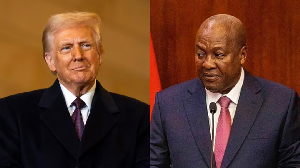
 US President Donald Trump (L) and the President of Ghana John Dramani Mahama
The United States wants to renegotiate a contentious $109 million (approx. GH₵1.27 billion) health agreement with Ghana after Cabinet rejected the proposed agreement over national sovereignty and data security concerns.
President John Mahama revealed the diplomatic pivot during a public forum in Goaso, located in the Ahafo Region. President Mahama said the US government had requested further discussions to review contested provisions within the five-year aid package.
Diplomatic engagement and background
The proposed arrangement aimed to channel $109 million (approx. GH₵1.27 billion) into Ghana’s healthcare sector over five years. This package was designed to supersede certain funding streams previously managed through the United States Agency for International Development.
President Mahama noted that Washington had requested renewed talks following Cabinet’s rejection of the proposal.
“The health compact the Americans brought to us, I have talked about it when I was in New York, so everyone knows about it. Later, they came back and said they wanted us to sit down and discuss the clauses we object to in the compact, with a view to either amending or removing them. We will sit down with them and discuss,” he stated.
Concerns over sovereignty and data
The rejection followed a formal review by the Ministry of Health, which submitted an evaluation to Cabinet. Officials identified several restrictive conditions that conflicted with national interests.
Chief among the objections were mandates requiring Ghana to surrender sensitive biological and medical data. The text demanded access to local pathogen profiles and individual healthcare records.
President Mahama questioned the rationale behind these demands during an appearance at the Council on Foreign Relations in New York. “It states that we shall give the United States our pathogen profile.
I’m sure there are medical experts who understand that better than me. And it also says we should give our medical records. I mean, who takes another country’s medical records?” he remarked.
Regulatory and financial friction
Additional friction points involved financial commitments and regulatory oversight. The text obliged Accra to allocate domestic counterpart funding for the initiative.
Simultaneously, the pact sought to curtail the jurisdiction of the Food and Drugs Authority. Specifically, it would have limited the agency’s ability to inspect pharmaceutical imports entering the country through the programme.
Characterising the totality of these stipulations, the Ghanaian leader offered a blunt assessment. Describing the conditions, he said, “I mean, it was humiliating.”
Regional drive for health independence and self-reliance
Ghana’s decisive response resonates across Africa, where nations increasingly prioritise health sovereignty, domestic regulatory autonomy and data protection.
The decision reflects a broader continental ambition to reduce reliance on external bilateral funding in favour of self-sustained healthcare infrastructure.
Initiatives across the region now place greater emphasis on local pharmaceutical production, indigenous research and equal partnership frameworks.
Cabinet ultimately halted the process to protect domestic regulatory powers and data privacy. The decision underlines a growing trend among developing nations demanding equal partnership, operational sovereignty and strict data governance in foreign aid agreements.
Upcoming discussions will determine whether both nations can negotiate terms that respect Ghanaian sovereignty while securing developmental support.

Copyright © 1994 - 2026 GhanaWeb. All rights reserved.










