



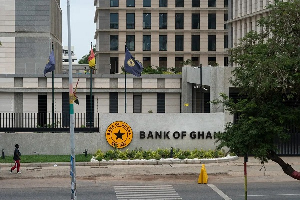
 The Bank of Ghana (BoG)
The Bank of Ghana (BoG) is proposing new rules to ensure banks have enough readily available funds to meet customer withdrawals and other financial obligations during periods of economic stress.
Under the proposed rules, banks must hold enough cash and other easily accessible assets to cover expected net cash outflows over 30 days of severe financial pressure.
The proposal is contained in the Liquidity Coverage Ratio (LCR) Directive, 2026, published on October 9, 2026.
Government raises GH¢1.54 billion above T-bill target
The central bank aims to prevent situations where banks struggle to meet financial obligations because they lack sufficient readily available funds.
Under the draft directive, banks must maintain a minimum Liquidity Coverage Ratio of 100%.
This means that for every GH¢100 a bank is expected to pay out, net of expected inflows, over 30 days of financial stress, it must hold at least GH¢100 in qualifying liquid assets.
These assets may include cash, eligible funds held with the Bank of Ghana and certain government securities that can be quickly converted into cash.
The proposed requirement is expected to strengthen banks’ ability to withstand sudden withdrawals, funding shortages and other financial pressures.
Banks will also be required to regularly assess their liquidity positions to determine whether they can withstand unexpected financial stress.
The central bank is proposing September 1, 2027, as the effective date for the new rules, with banks expected to have their operations and systems ready by August 31, 2027.
The proposal also introduces regular reporting requirements to enable the Bank of Ghana to monitor banks’ compliance and assess their ability to meet financial obligations.
Meanwhile, the central bank has given banks, financial institutions and the general public until November 30, 2026, to submit comments on the proposed rules.
The feedback will be considered before the directive is finalised.
Food prices rise sharply in North East while Accra, Upper West record drops
The move forms part of efforts to strengthen Ghana’s banking system and reduce the risk of financial difficulties at one bank spreading to other institutions.
DR/MA
Inside Ghana’s Abandoned Engineering Powerhouse: What Went Wrong?

Copyright © 1994 - 2026 GhanaWeb. All rights reserved.










