



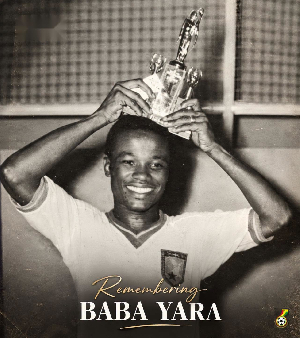
 Osman Seidu Maada Aka Baba Yara
Ghana’s football history would be incomplete without the remarkable story of Baba Yara, the legendary winger whose dazzling performances earned him the title “King of Wingers” before a devastating car accident cut short his career at just 26.
Born Osman Seidu Maada on October 12, 1936, in Kintampo Zongo in the Bono East Region, Baba Yara remains one of the greatest talents to have represented Ghana, leaving behind a legacy that continues to inspire generations of footballers and fans.
Before becoming a household name in Ghanaian football, Yara worked as a horse jockey at the Accra Turf Club between 1950 and 1955. His footballing talent, however, soon took center stage, paving the way for a career that would establish him as one of the country’s most feared attacking players.
He joined Asante Kotoko in 1955 and announced himself in spectacular fashion, scoring a hat-trick on his debut against Dunkwa Town IX. Wearing the number seven shirt, he quickly became a dominant force, renowned for his pace, attacking instincts, and ability to find the back of the net despite operating primarily from the wing.
During his six-year spell with Kotoko, Baba Yara reportedly scored more than 90 goals. His performances also earned him a place in President Kwame Nkrumah’s Real Republicans, a team that won consecutive league titles in 1961 and 1962.
His exploits at club level translated seamlessly to the international stage. Baba Yara made his Black Stars debut in 1955 against Nigeria at the Accra Sports Stadium, helping Ghana secure a commanding 7-0 victory. He scored twice and provided four assists in what became a memorable introduction to international football.
His consistency and brilliance earned him Ghana’s Player of the Year award in 1959 and 1960. Across his international career between 1955 and 1963, he is credited with 51 appearances and 49 goals, an extraordinary return for a player whose primary role was to create opportunities from the flanks.
However, just as his career was reaching its peak, tragedy struck.
On March 4, 1963, Baba Yara was involved in a road accident when the team bus crashed near Nkawkaw. The incident left him with a severe spinal injury, effectively ending his playing career at the age of 26.
The injury confined him to bed for six years. Despite the promise and achievements of his relatively brief career, he never recovered sufficiently to return to the game he had helped define.
Baba Yara died on May 5, 1969, at the Korle Bu Teaching Hospital in Accra, aged 32. His death marked the end of a life that had brought immense excitement to Ghanaian football but was tragically cut short before its full potential could be realized.
His contribution to the sport, however, has endured. Kumasi’s principal sports venue, originally known as the Kumasi Sports Stadium, was eventually renamed the Baba Yara Sports Stadium in his honor. The renaming, carried out between 2004 and 2005, cemented his place among Ghana’s most celebrated sporting figures.
The stadium itself has a history dating back to 1957, when it was built by the United African Company (UAC). It was officially inaugurated as a designated football venue in 1959, received its first formal seating stands in 1971, and underwent a major structural reconstruction in 1977.
Further redevelopment followed ahead of the 2008 Africa Cup of Nations, including the replacement of the old west stand with a modern two-tier structure featuring press, VIP, and corporate facilities. The venue also received additional pitch and facility upgrades in 2022 ahead of Ghana’s high-profile World Cup playoff against Nigeria.
Located on Hudson Road in Kumasi, the stadium has a grass playing surface, an athletics track, and a reported seating capacity of 40,528. It serves as a major home venue for Asante Kotoko and King Faisal and has hosted several continental tournaments, including the 1963, 1978, 2000, and 2008 Africa Cup of Nations.
Today, the name Baba Yara represents more than a football stadium. It recalls the story of a gifted winger whose goals, creativity, and exceptional talent made him a national icon, even though a tragic accident denied him the opportunity to extend his remarkable career.
More than five decades after his death, the King of Wingers remains an enduring symbol of Ghanaian football excellence—a legend whose influence outlived the years he spent on the pitch.
EA

Copyright © 1994 - 2026 GhanaWeb. All rights reserved.










