



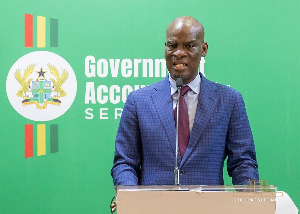
 Haruna Iddrisu is Ghana's Minister of Education
Education Minister Haruna Iddrisu has warned that the growing influence of money in Ghanaian elections is contributing to corruption, calling for measures to prevent financial resources from determining who gets elected to public office.
The Tamale South MP questioned whether political parties are doing enough to ensure that their internal processes are democratic and not dominated by financial influence.
“But ultimately, you want to reduce the money politics and money being the yardstick in determining who gets elected to Parliament and who does not, because that’s what is building up the corruption,” he said.
'I will not succumb to cheap blackmail' - Haruna Iddrisu responds to US$2.5m bribery allegation
He added, “Our corruption is driven by need and opportunity.”
Haruna Iddrisu made the remarks while discussing the implications of a recent Supreme Court ruling on an expanded delegate system.
He raised concerns about what the ruling could mean for Ghana's democratic process, particularly in relation to the possibility of state funding for political parties and efforts to reduce the influence of money in political competition.
The minister further questioned whether the development could reopen discussions about public funding for political parties, even if such support was limited to a minimum amount or based on a specific threshold.
“What does that hold for an opportunity for state financing of political parties, even if it is a certain minimum or a threshold?” he asked.
His comments highlighted state financing as a possible issue for further consideration, rather than a formal proposal for government funding of political parties.
Iddrisu also called for greater scrutiny of how political parties were complying with constitutional requirements for democratic internal processes.
“Are the political parties responding to that? And how are they responding to that? That must be of interest to all of us,” he said.
The former Minority Leader further underscored the need for political actors to tolerate differing opinions and constructive criticism as part of efforts to strengthen Ghana's democracy.
He argued that allowing dissent and encouraging constructive criticism could contribute to better governance and improve the lives of citizens.
“But I think that for the good of our democracy, it’s good to tolerate dissent, and it’s good to tolerate constructive criticism,” he said.
NA/EB

Copyright © 1994 - 2026 GhanaWeb. All rights reserved.










