



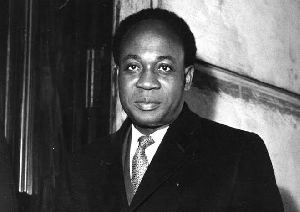
 Dr Kwame Nkrumah
On October 14, 1957, TIME Magazine reported on a legal battle over deportation, parliamentary power and citizens’ rights that exposed the tensions facing Ghana just seven months after independence.
Ghana’s commitment to the rule of law came under international scrutiny barely seven months after independence, when a dispute over the deportation of two Ashanti Muslim leaders triggered a fierce legal battle over the powers of Parliament and the fundamental rights of citizens.
On October 14, 1957, TIME Magazine published a report titled “Ghana: The Sovereignty of Law,” examining a case that placed Prime Minister Kwame Nkrumah’s government at the centre of a debate over the limits of state power in the newly independent country.
The dispute raised a fundamental question for Ghana’s emerging democracy: could Parliament exercise sweeping legislative authority without judicial scrutiny, even when citizens argued that their basic rights had been violated?
The deportation dispute that tested Ghana’s democracy
According to TIME, the government had deported two Ashanti Muslim leaders on the grounds that their presence was “not conducive to the public good."
The two men challenged the decision in court, seeking to defend their rights as Ghanaian citizens. The government subsequently pushed through legislation ordering their expulsion, intensifying the dispute over whether the executive and Parliament could override claims to individual liberty.
The case was heard in Kumasi, the Ashanti regional capital, where lawyers representing the two sides presented sharply contrasting interpretations of the law.
Attorney-General Geoffrey Bing, arguing for the government, maintained that Parliament possessed extensive legislative authority.
TIME quoted him as arguing that Ghana’s Parliament had “absolute and complete power to legislate on any subject whatever," with the courts unable to review an act unless it was specifically prohibited by the Constitution.
The position placed parliamentary sovereignty at the heart of the case, raising concerns about the extent to which the courts could intervene when government action was challenged on constitutional grounds.
Lawyer Phineas Quass, representing the absent opposition leaders, mounted a strong challenge to the government’s position.
“This statute breaks two fundamental rights of a citizen, namely, to live in his own country and to have access to the courts,” Quass argued, according to TIME.
He further questioned the government's reliance on the constitutional language of “peace, order, and good government” to justify the deportations.
“I know of no precedent for suggesting that [the constitution’s] words—‘Peace, order, and good government’—have been used anywhere to justify a breach of the fundamental rights of people everywhere to reside in the state in which they are citizens,” he said.
The arguments exposed a central dilemma confronting Ghana in its early months of independence: how to balance the authority of an elected government with the rights of individuals and the independence of the judiciary.
Why the case mattered beyond Ghana
The legal battle was significant not only because of its implications for the affected individuals but also because it touched on a wider constitutional debate across the Commonwealth.
TIME cited a recent observation by Australian Prime Minister Robert Menzies, who warned against treating parliamentary authority and the rule of law as interchangeable concepts.
“Perhaps we do not always understand that ‘the rule of law’ and ‘the rule of Parliament’ can be separately stated in words but are not easily separated in fact,” Menzies said.
He added, "Self-government is not only a political conception. It is a legal conception. In short, I don’t believe there can be any form of parliamentary self-government without a recognition of the rule of law.”
The observation captured the broader challenge confronting Ghana as it sought to establish its institutions after British colonial rule. Political independence had transferred substantial governing responsibilities to Ghanaian leaders, but the exercise of those powers still had to contend with questions of legality, constitutional interpretation, and individual liberty.
The case also reflected the difficult relationship between the central government and political minorities, including groups in Ashanti and the Northern Territories. TIME’s report described tensions over regional rights and the government's efforts to consolidate its authority.
However, the magazine's account should also be read as a contemporary foreign publication's interpretation of the political climate, rather than as a neutral or exhaustive account of every side of the dispute.
Ghana’s constitutional foundations after independence
Ghana attained independence on March 6, 1957, under a constitutional framework that established new arrangements for executive authority, Parliament, and the courts.
Historical records published by Ghana’s Judicial Service show that the 1957 Constitution renamed the Legislative Assembly as the National Assembly and retained a parliamentary system in which legislation passed by the Assembly required the Governor-General’s assent.
The Constitution also guaranteed the office of chiefs as recognised under customary law and usage, providing for a system of regional houses of chiefs.
These arrangements reflected the challenge of governing a country whose institutions combined inherited British legal and parliamentary structures with established Ghanaian traditions and customary practices.
The relationship between customary authority and the formal legal system was particularly important in a country where traditional institutions continued to influence community life, land administration, and dispute resolution.
Yet the October 1957 case reported by TIME was principally a dispute over deportation, parliamentary power, and citizens’ rights. It should not be confused with a case specifically about the constitutional integration of chieftaincy and customary law, although both issues formed part of the wider task of shaping Ghana’s post-independence legal order.
The tensions surrounding traditional authority would continue to feature prominently in Ghanaian politics as Nkrumah’s government sought to consolidate central state power.
A debate that remains relevant
TIME reported that arguments were still continuing in Kumasi at the end of the week, with British Justice H. C. Smith expected to deliver a decision that could help determine the meaning of law and liberty in Ghana.
The magazine described the case as one that would go far in deciding the meaning of law and liberty in the country. Its report remains a historical record of the constitutional questions confronting Ghana at a formative moment in its political development.
Nearly seven decades later, the debate over the relationship between government authority, parliamentary power and individual rights remains central to constitutional democracy.
Ghana’s 1992 Constitution expressly guarantees the independence of the judiciary and establishes a framework for the protection of fundamental human rights. It also recognises customary law as part of the country's legal system and guarantees the institution of chieftaincy under Article 270. https://www.judicial.gov.gh/index.php/chieftancy
The historical significance of October 14, 1957, therefore lies in more than the publication of a foreign magazine report. It offers a glimpse into the difficult questions Ghana faced soon after independence: how to exercise political power, protect citizens' rights, and build institutions capable of holding government accountable.
For a young nation determined to govern itself, the dispute was an early reminder that independence was not simply about transferring power. It was also about defining the legal limits within which that power could be exercised.

Copyright © 1994 - 2026 GhanaWeb. All rights reserved.










