



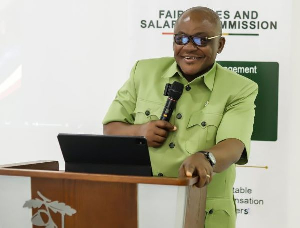
 Dr George Smith Graham is the Chief Executive of the FWSC
Ghana is planning to transition from the Fair Wages and Salaries Commission (FWSC) to the proposed Independent Public Emoluments Commission (IPEC) to address inequalities in public sector pay and improve fairness in how workers are remunerated.
But what will the proposed change mean for public sector workers?
Fair Wages and Salaries Commission engages striking teachers over service conditions
Chief Executive of the FWSC, Dr George Smith Graham, explained that workers with similar basic salaries could receive different total compensation because of differences in allowances, housing, transport support and other benefits.
Speaking at a media capacity-building workshop on the proposed transition, he said IPEC would provide a broader framework for determining and reviewing public sector remuneration.
The proposed commission would consider salaries alongside allowances, benefits, board fees, executive remuneration, performance bonuses and certain retirement-related payments, depending on the final law.
“The proposed Commission would provide a stronger national framework for determining, reviewing, certifying, monitoring and reporting on covered public sector remuneration, subject to the Constitution,” Dr Graham said.
He explained that the aim was to assess workers’ full remuneration packages rather than focus only on their basic salaries.
Dr Graham stressed that fairness would not mean paying every worker the same salary. He said differences in job responsibilities, skills, risks and working conditions could justify different levels of pay.
The proposed commission is expected to develop common standards for assessing jobs and reviewing remuneration. It would also assess pay proposals based on evidence and the government’s ability to pay.
Dr Graham said the transition would build on the existing pay system rather than completely dismantle it.
He added that the process would be carefully managed to avoid widespread labour agitations.
“We are thinking very carefully. A change to IPEC does not mean complete dismantling of the previous system. It will be looking at the old system and improving on the old system and seeing how you can get the old system to work better,” he stressed.
He explained that the reform was aimed at promoting fairness and equity, not simply increasing salaries.
“Our objective in our work is not increases in salaries. The objective in our work is to ensure that there is fairness and equity,” he said.
He cautioned workers against expecting automatic or significant salary increases as a result of the proposed change.
“We can assure everyone that there will be fairness, but we cannot assure anybody that there will be astronomical increases in their salaries,” he added.
The proposed transition is expected to begin with stakeholder consultations and the legislative process to establish IPEC.
The next stages would involve establishing the commission as a constitutional body through the relevant constitutional process.
A separate constitutional amendment process, including a national referendum, is envisaged to determine whether office holders covered by Article 71 should come under its mandate.
Dr Graham said the transition would require more than establishing a new institution.
‘I’m surprised about GAUA strike’ - Fair Wages boss
It would also involve developing policies, reviewing pay structures, improving data and preparing the systems needed to implement the reform.
He said the success of IPEC would depend on the quality of the law establishing it, effective implementation and public confidence in the commission.
MAG/VPO
Inside Ghana’s Abandoned Engineering Powerhouse: What Went Wrong?

Copyright © 1994 - 2026 GhanaWeb. All rights reserved.










