


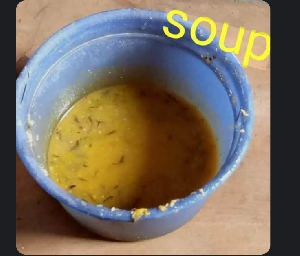
 The ‘Zontoli’ Story Is Changing Behind Bars
The Director-General of the Ghana Prisons Service, Patience Baffoe-Bonnie (Esq.), says conditions surrounding the controversial prison meal popularly known as “Zontoli” have improved following an increase in the daily feeding allowance for inmates and efforts by the Service to supplement government-provided food.
Speaking before Parliament’s Public Accounts Committee (PAC) on Tuesday, October 20, she said the Service had introduced measures to improve the quality of meals served to inmates, including the establishment of vegetable farms, fish ponds and poultry units at prison facilities across the country.
Baffoe-Bonnie appeared before the committee alongside Interior Minister Mohammed Mubarak Muntaka to respond to issues arising from the Attorney-General’s report.
Responding to questions from the committee, chaired by Abena Osei-Asare, the Prisons Director-General said the Service was determined to improve inmates’ welfare and ensure they were treated with dignity.
“The current government increased our feeding rate right after a meeting like this last year, from GH¢1.80 to GH¢5, which was a very good step,” she said.
She explained that management had introduced the Director-General’s Kitchen Support Project to complement the government’s intervention and improve the nutritional quality of meals served to inmates.
Under the initiative, every prison facility is expected to establish at least a small vegetable farm, a fish pond and a local poultry unit to supplement food supplies.
“So if you go around now, you can see a marginal change, even in the feeding regime of the inmates,” Baffoe-Bonnie said.
Asked whether the changes meant the notorious “Zontoli” meal was a thing of the past, she responded: “Zontoli has changed into something else.”
She added that she could provide pictures of the meals currently served to inmates as evidence of the improvements.
The increase in the daily feeding allowance from GH¢1.80 to GH¢5 represents an additional GH¢3.20 per inmate per day, equivalent to an increase of about 177.8 per cent.
However, the allocation remains a daily amount intended to cover inmates’ feeding needs, making the Service’s efforts to supplement government supplies significant.
The government’s feeding-rate adjustment was announced in 2025 as part of efforts to improve prison conditions. The Ghana News Agency reported in September 2025 that prison authorities had previously described the GH¢1.80 allocation as grossly inadequate for providing meals to inmates.
Church of Pentecost commended for prison infrastructure
Beyond feeding, Baffoe-Bonnie and the Interior Minister commended The Church of Pentecost for its contribution to prison infrastructure and rehabilitation.
The minister said the church deserved special recognition for supporting the construction of four prison camps, arguing that greater involvement from other religious organisations could help transform conditions across the country’s correctional facilities.
He specifically praised the facility at Damongo, describing the church’s contribution as significant, and acknowledged the donation of a bus to support its operations.
The minister also explained that prison camps generally accommodate selected categories of inmates, particularly those approaching the end of their sentences and considered suitable for the arrangements.
He said the government was exploring ways to upgrade the Damongo facility into a fully operational prison by providing the necessary infrastructure and security.
According to him, the proposal could help accommodate more inmates and ease pressure on overcrowded facilities, including the Kumasi prison, which he said had a capacity of about 500 inmates.
Baffoe-Bonnie added that work on a perimeter wall at the Damongo facility was approximately 40 per cent complete, with The Church of Pentecost supporting the project.
The Ghana Prisons Service has previously credited the church with supporting prison development and rehabilitation efforts. In November 2025, President John Dramani Mahama commissioned the 300-capacity Damongo Camp Prison, with the Interior Minister and the Prisons Director-General acknowledging the partnership between government and the church.
Virtual counselling clinic to support inmates and officers
The Prisons Director-General also disclosed that the Service was establishing a virtual psychosocial clinic to address the shortage of psychologists and expand access to counselling.
She said trained prison officers and volunteers from the public were being brought on board to provide counselling services to both inmates and prison staff.
The initiative, she explained, was intended to improve access to professional support and strengthen rehabilitation efforts.
Mrs Baffoe-Bonnie further announced that the Service would organise a major exhibition in November to showcase products manufactured by inmates, including prefabricated structures and agricultural implements.
She invited members of the public to attend the exhibition, saying the quality of the work produced by inmates would demonstrate the potential of vocational training and rehabilitation programmes.
The initiatives form part of broader efforts to help inmates acquire practical skills, improve their welfare and prepare for reintegration into society.
‘Royals’ instead of prisoners
In another aspect of her presentation, Mrs Baffoe-Bonnie said the Service was adopting a more humane approach to inmate management, including the language used to describe people in custody.
She said the aim was to help inmates feel valued and encourage their participation in rehabilitation programmes.
“We just want them to feel loved,” she said, explaining that the Service was promoting a culture that treats inmates with dignity rather than defining them solely by their offences.
She also stressed the need to recruit more personnel with the appropriate expertise to support counselling and rehabilitation.
The Interior Minister, meanwhile, praised prison officers and management for their efforts to improve conditions despite the challenges confronting the Service.
The hearing also turned to concerns about inmates allegedly using smuggled mobile phones to commit mobile money fraud. A question raised during the proceedings referred to a January 2018 Daily Graphic report and the Prisons Service’s own acknowledgement of phone smuggling.
For now, the Prisons Service says improvements to feeding, infrastructure and rehabilitation are changing life behind bars. Whether the reported changes will permanently end the conditions associated with “Zontoli” will depend on sustained funding, effective implementation and continued monitoring of the quality of meals served to inmates.
EA
Guns and Drugs: Dr Adam Bonaa Warns of Growing Security Threat to Ghana

Copyright © 1994 - 2026 GhanaWeb. All rights reserved.










