


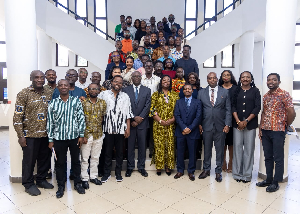
 Finance Minister Dr Cassiel Ato Forson with faculty and students at the University of Ghana
Finance Minister Dr Cassiel Ato Forson has stressed the need for value for money in the implementation of the government’s New Economy agenda, saying Ghana cannot afford to waste resources that should be used to create opportunities for its young people.
Addressing faculty and students at the University of Ghana, Dr Forson said investments under the programme must be assessed based on their ability to create jobs, improve productivity, strengthen businesses and enhance livelihoods.
He said the success of the New Economy agenda would depend not only on the amount of money invested but also on the tangible benefits delivered to Ghanaians.
“The New Economy must be disciplined because the future of young people is too important for waste,” he declared.
“Every cedi must work. Every project must pass the test of value for money.”
The Finance Minister outlined five key questions that should guide decisions on investments under the programme, stressing that every project must contribute meaningfully to Ghana’s economic transformation.
“Will it raise productivity? Will it create jobs? Will it expand exports? Will it support private enterprise? Will it improve the lives of Ghanaians?” he asked.
“If it cannot answer these questions, then it does not belong at the centre of this transformation,” he added.
Dr Forson said the government’s approach to the New Economy agenda must be anchored in productive investments capable of generating sustainable economic opportunities, particularly for young people seeking jobs and avenues to build businesses.
He emphasised that public resources must be directed towards projects that deliver measurable outcomes rather than investments that fail to produce meaningful economic and social benefits.
His remarks placed spending discipline at the centre of the government’s efforts to transform the economy, with job creation, export expansion and private-sector growth identified as key measures for assessing the programme’s impact.
The Finance Minister, however, noted that fiscal discipline should not prevent the government from pursuing ambitious policies to address the country’s economic challenges.
“It must be bold because the scale of the problem is large,” he said.
He explained that Ghana’s economic transformation would require deliberate action, sustained commitment and investments capable of addressing structural challenges while opening up new opportunities for businesses and workers.
Dr Forson also called for a collective national effort to implement the agenda, stressing that government alone could not deliver the transformation the country needed.
“And it must be national because transformation cannot be carried by government alone,” he stated.
He underscored the importance of collaboration among government institutions, the private sector, academia and other stakeholders in driving the country’s economic development.
According to him, achieving the objectives of the New Economy agenda would require a shared commitment to ensuring that investments translate into productive economic activity, stronger businesses and improved living standards.
His message to the university community highlighted the importance of linking economic policy to the aspirations of young Ghanaians, whose employment prospects and future opportunities will be central to the country’s long-term development.
The emphasis on value for money also signals the importance of accountability in implementing the programme, ensuring that public funds are used efficiently and that projects deliver the intended results.
Dr Forson maintained that the New Economy agenda must be disciplined in its use of resources, bold in confronting economic challenges and national in its implementation if it is to deliver lasting benefits to Ghanaians.

Copyright © 1994 - 2026 GhanaWeb. All rights reserved.










